
Cultivating Sunshine: Agricultural Solar Leasing and the Michigan Right to Farm Act
Abstract
In recent years, solar energy has become a popular form of sustainable energy in Michigan. Simultaneously, financial burdens on small and midsize farms are rising, threatening the future of Michigan’s many farming communities. Modern times may require Michigan farmers to farm with less traditional methods, such as harvesting solar energy for profit. Due to the sheer size of most solar facilities, most solar developers look to placing their facilities on agricultural land by offering local farmers a solar lease. Under these contracts, a farmer leases their land for solar panels for a set period of time. While these contracts are highly beneficial to the farmer, a wide range of social conflicts arise when siting solar facilities on farmland, particularly in the context of zoning controls and neighboring property rights. Due to local government tensions and community pressures, farmers are often prevented from engaging in solar leasing on their farmland.
While there have been attempts to regulate solar siting in Michigan, including the recently promulgated Public Act 233, none have been sufficient to resolve conflicts at the local level. An alternative, innovative solution may lie within state Right to Farm Acts (RTFAs). These statutes have successfully controlled farm activity in all fifty states for over forty years and could evolve into mechanisms for solar siting. For instance, New Jersey has regulated solar energy under its RTFA since 2010, using a case-by-case preemption method to avoid a total loss of local governance. If the Michigan Legislature chooses to regulate solar energy under the Michigan RTFA, it should use caution to carefully balance local government interests with a farmers-first approach.
Introduction
The Ostrander family lives in the quiet farming community of Milan Township, Michigan.[1] The Ostranders have owned farmland in the township for more than 150 years, proudly residing on the very same plots of land that became their homesteads in the 1870s.[2] In the last decade, the Ostranders were forced to sell most of their land due to financial hardship but were determined to find a way to keep the remaining acreage in their name.[3] One day, a representative of a solar company knocked at the Ostranders’ door and asked if the family would be interested in leasing their remaining land for solar panels.[4] The Ostranders accepted the proposal, as the only other option would be to sell off the farmland entirely.[5] After all, harvesting the sun still counted as farming in the Ostranders’ eyes.[6]
Although Milan Township had a solar ordinance that permitted large-scale solar projects on zoned agricultural land, outrage erupted among the township residents when solar crews began surveying the Ostranders’ property.[7] Soon, angry locals began attending board meetings to argue against solar energy in the township, regardless of its legality within the ordinance.[8] Meetings often descended into shouts, threats, and demands, with both township residents and non-residents vehemently fighting against the board.[9] Neighboring property owners argued that the solar panels would not be a pleasing view and the enjoyment of looking at the Ostranders’ farmland would be taken away from them.[10] Complainants began spreading misinformation, asserting that grass would no longer grow in people’s yards, gardens would burn up, and basements would flood.[11] Even so, the most popular argument was that the Ostranders’ farmland belonged to the community.[12] The board reluctantly succumbed to the pressure, banning all solar projects on agricultural land in the township and canceling the previous solar ordinance entirely.[13]
The Ostranders’ story illustrates that Michigan farmers, even in the modern age, are being denied the opportunity to farm solar energy when the requisite township ordinances expressly allow it.[14] Local uproar influences municipalities to deny land use permits for solar farms on farmland, regardless of the solar farm’s compliance with zoning conditions.[15] Because of this, farmers (through their contracting solar developers) resort to suing the township itself in an effort to reverse the denied permit.[16] This scenario is regrettably common, as most solar companies lease land from farmers due to the sheer acreage available for panels.[17] Thus, while the solar companies pursue the legal fight for a zoning permit, the farmers are left waiting for permission to produce solar energy, with the fate of their property and finances in the balance.[18]
An unexpected solution may be on the rise across the country: Right to Farm Acts (RTFAs).[19] State RTFAs are designed to bar nuisance suits against certain farming practices, but they have many other functions as well.[20] Relevant to this discussion, Michigan’s RTFA preempts local ordinances that clash with the generally accepted agricultural management practice (GAAMP) requirements defined by the Michigan Commission of Agriculture (MCA).[21] RTFAs protect farmers who perform certain activities on their property from the threat of litigation from their community, so long as those activities are performed within the restrictions set forth in the statute and the GAAMPs.[22]
This raises the question of whether solar energy could become a protected activity under the Michigan RTFA.[23] An examination of other states’ RTFAs suggests that the right to farm renewable energy is not a new concept.[24] For example, New Jersey’s RTFA was amended in 2010 to include the generation of wind, solar, and biomass energy as a protected agricultural activity, such that farmers engaging in those activities are immune from nuisance lawsuits.[25] Then, New Jersey promulgated conditions and restrictions that a solar farmer must comply with in order to obtain New Jersey’s RTFA protection, similar to Michigan’s GAAMPs.[26] In addition, New Jersey’s approach to RTFA preemption is more lenient and yields less controversy than Michigan’s full preemption provision.[27] Furthermore, the recent introduction of agrivoltaics into Michigan agriculture illustrates that the dual-utilization of farmland and solar facilities may have a distant but promising future.[28]
As a similar state-control method for solar siting, the Michigan legislature recently promulgated a statute that removes the majority of solar ordinance powers from local governments.[29] Effective as of November 2024, Michigan’s Public Act 233 pulls the power of solar energy permitting from the hands of local governments and vests that power within the Michigan Public Service Commission (MPSC).[30] As will be addressed later in this Note, Public Act 233’s future remains relatively questionable, as its requirements are widely seen as too interventionist and its implementation uncertain.[31] The new law may prove to be insufficient to resolve growing solar siting conflicts between locals, as it has effectively inflated those conflicts rather than dampened them.[32]
Solar siting conflicts in Michigan will burden the State’s energy efficiency and financial stability until some form of intervention successfully resolves the problem.[33] The fight among neighbors, farmers, solar companies, and local governments will undoubtedly continue under the new legislation due to its unpopular and uncertain procedures.[34] On the other hand, the Michigan RTFA’s requirements are relatively unambiguous and have been widely utilized by rural communities for more than forty years.[35] As the intersection between farmland and solar energy continues to grow, the Michigan Legislature may recognize that modern times require Michigan farmers to utilize less traditional farming activities, such as producing solar energy.[36] At the very least, shifting solar siting toward a farmer-first approach would mean security for farmers like the Ostranders who want to lease their land for solar development in times of hardship.[37] Due to its success in preempting local governance of many farm-related activities, the Michigan RTFA could serve a critical role in the future of solar siting on farmland.[38]
Part I of this Note discusses the range of benefits surrounding solar energy generation in Michigan and weighs competing interests regarding large-scale solar.[39] Part II evaluates various proposed solutions for solar siting, including state interventions such as various RTFAs across the country and Michigan’s recently enacted Public Act 233.[40] Part III assesses the potential to use the Michigan RTFA to protect solar energy generation and addresses important counter-arguments to such a solution.[41]
I. The Benefits and Rising Conflicts of Solar Energy
Solar energy generation has been a beneficial practice for the state of Michigan, specifically in terms of energy efficiency and economic growth.[42] Nevertheless, there is large social divide amongst communities in the Midwest when it comes to supporting large-scale solar facilities.[43] Balancing these competing interests creates a predicament for the Michigan Legislature and many other state legislatures— choosing whether to regulate solar siting at the state level or leave doing so to local governments.[44] There is strong support and opposition for either choice.[45] The Michigan Legislature recently made this decision when it promulgated Public Act 233, and as such, it is important to understand how the Legislature came to its conclusion that state intervention was necessary.[46] A discussion of the benefits and conflicts that arise from solar farming will shed light on this regulatory dilemma.[47]
A. Solar Energy’s Benefits: Efficiency, Economics, and Rural Prosperity
As the solar industry grows within the United States, its benefits often entice Congress and state legislatures to enact legislation to promote solar energy generation, particularly for the benefit of rural and farming communities.[48] Utility-scale solar farms have more than doubled in their efficiency since the last farm bill was passed five years ago, which propelled the 2024 Biden administration to consider new methods to integrate solar into agriculture practices.[49] Large-scale solar farms have a wide range of benefits, but focusing on the three main benefits—efficiency, economic incentives, and the preservation of farming communities—will suffice for the purposes of this Note.[50]
First, Michigan’s solar energy production is growing more and more efficient each year.[51] Between 2016 and 2017, Michigan’s solar energy generation grew from less than 6 megawatts to 107 megawatts.[52] At the beginning of 2021, all of Michigan’s solar energy farms combined were able to power roughly 84,000 homes at forty-one kilowatts per hour.[53] Today, the Sauk Solar Park, located in Branch County, is the newest and largest solar facility in Michigan, producing an astounding 150 megawatts of electricity, which is enough to power 40,000 Michigan homes on its own.[54] Although the townships within Branch County are relatively small farming communities, the Sauk facility is capable of powering a city roughly the size of Ann Arbor, bringing enormous energy efficiency to the Branch area.[55]
Second, large-scale solar farms commonly carry economic incentives with their installation.[56] In 2021 alone, more than 730,000 jobs were created in the Midwest due to renewable energy companies, with solar installation being the fifteenth fastest-growing job.[57] A prime example of the broad economic benefits that solar farms can produce is the Sauk solar project discussed previously.[58] The Sauk Solar Park created over 350 jobs during the construction of the facility alone, and it continues to provide employment for solar employees who maintain the facility each day.[59]
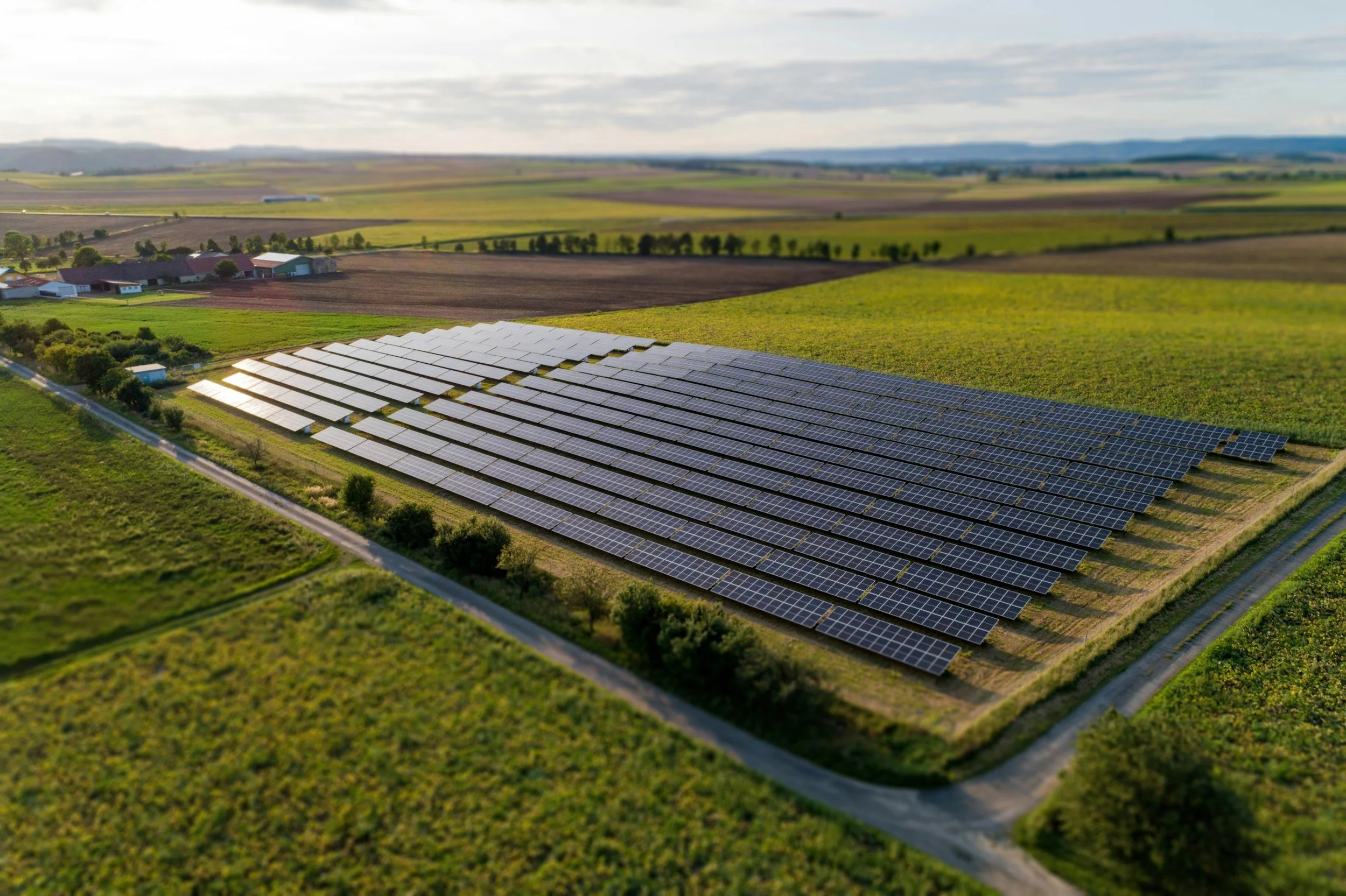
Lastly, rural communities across the United States greatly benefit from the production of solar energy within their localities, particularly on farmland.[60] A trending development in Michigan is the leasing of farmland to solar developers (generally termed solar leasing) that allows farmers to halt crop production, wait 20-30 years for their land to replenish its nutrients, and receive payment from the developers in exchange.[61] This exchange operates as a profitable, long-term method for farmers to preserve their land, maintaining the possibility of restoration to cropland years later.[62] The economic value that farmers can receive from solar leasing is significantly more than they would earn harvesting crops from the same land.[63] As such, solar leasing preserves those family farms that find it difficult to operate solely on traditional farming.[64] In combination with this, localities gain both the capital and renewable energy that a solar lease contract generates.[65] Thus, solar leasing is an effective way to boost local economies while simultaneously preserving rural ways of life.[66]
Another relatively hidden incentive to installing solar facilities on farmland is the concept of agrivoltaics.[67] Agrivoltaics combines solar facilities with active farmland, such that both practices are utilized simultaneously.[68] To achieve this synergy, solar panels are placed on farmland and raised by stilts such that crops can be grown beneath the panels, and in some instances, leaving enough space for grazing animals to graze and maintain the vegetation.[69] Agrivoltaics have many benefits, such as minimizing water evaporation over cropland to reduce water use by farms, increasing food production by creating the optimal shade and sunlight ratio for vegetation growth, and increasing solar production to diversify income for communities that utilize the system.[70] This dual-utilization of farming and solar energy can—and has—provided Michigan with a mode of sustainable agriculture that helps to meet food and energy production needs.[71]
B. The Various Sources of Solar Conflicts Michigan
Unfortunately, the benefits of solar energy are often offset by the various conflicts that arise regarding the implementation of solar facilities.[72] Common challenges include the large gap between the support and opposition from differing groups of Michigan citizens, zoning implications and local government power, and nuisance litigation.[73] These obstacles result in burdensome litigation and pushback against large-scale solar that jeopardize a solar developer’s time, money, and reputation within their community.[74]
1. The Solar Social Gap, Local Conflicts, and Land Use Concerns
While the support for solar energy is on the rise in the Midwest, there remains a noticeable lag in the number of solar facilities actually implemented, particularly in Michigan.[75] This gap was examined in a 2022 study published in the Journal of Energy Research & Social Science, wherein it was determined that a myriad of factors—aesthetics, noise, negative impacts on rural culture, local energy independency, biodiversity, and more—influence state citizens’ perspectives on large-scale solar installations in their respective communities.[76] The authors evaluated four communities in Michigan to develop their conclusion, interviewing the communities’ residents, solar developers, and local government officials to determine the largest concerns for solar among the differing parties.[77] The most common concerns found among residents were negative aesthetic impact, decreased property values, and misuse of agricultural land.[78] On the contrary, the most common benefits of solar according to residents were economic benefits to lease-holding landowners, economic benefits to the community, and clean sources of energy.[79] Land use concerns were an important factor for non-farming residents of agricultural property, the concerns being that solar facilities would become a permanent agricultural land use that would impact local culture.[80] Importantly, many residents desired a transparent decision-making process for large-scale solar where their concerns could be voiced and heard by local officials, with some residents preferring an opportunity for a direct citizen vote on incoming projects.[81]
The not in my backyard (NIMBY) mindset also plays a large role in the local conflicts surrounding solar farms.[82] Because solar farms require adequate sun and space, local communities often fear that their scenic farmlands will be subject to industrialization when a solar developer comes to town.[83] There is real concern about pastoral lands losing value and changing landscapes entirely.[84] For this reason, it is important to resolve solar siting conflicts in a manner that protects rural culture and will not impede too greatly on residents’ aesthetic preferences.[85]
To add to the controversy, not all farmers are on board with the idea of putting solar facilities on farmland, regardless of the economic incentives.[86] Farmers who are pro-solar assert that they are allowed to make these kinds of decisions with their private property and that solar leasing is simply another financial transaction to help their business.[87] Even the Michigan Farm Bureau has recognized that each farmer must decide what is best for their land when it comes to solar leasing.[88] On the other hand, farmers who reject solar leasing assert that it will reduce food production, as more and more land will be used for solar panels instead of crops.[89] Some farmers agree that investing in renewable energy is a good choice, but they are unwilling to part with the preservation of traditional farmland.[90] There are also many farmers who refuse to speak on the issue due to community pressures and the stigma that surrounds being publicly supportive of solar leasing in rural areas.[91]
Lastly, while solar panels cause little harm to human or environmental health, an essay by the National Renewable Energy Laboratory found that a disconnect exists between science and what the public believes regarding the safety of solar cells.[92] The essay asserts that solar facilities do not produce the harmful chemicals and toxins that are often the conversation of township meetings.[93] The false assertion that solar energy causes harmful environmental impacts has been one of the many reasons that developers are unable to successfully implement their facilities, even if they have complied with all required municipal procedures.[94]
2. Local Governance and Zoning Powers
One of the largest roadblocks to Michigan solar arises within land use law, where social and cultural qualms against solar energy are enforced through local governance and zoning powers.[95] Local governments have the power to deny or grant permits for solar developers that wish to begin construction within a zoned area of the municipality.[96] Challenges arise when permits are denied due to political influence on local governments and community uproar rather than the solar project’s true compliance with zoning conditions.[97] Thus, to fully understand the obstacles that solar developers, farmers, and local government officials face, an overview of Michigan’s local governance and zoning law is essential.[98]
There are two major statutes that govern zoning and local ordinances in Michigan: the Michigan Planning Enabling Act (MPEA) and the Michigan Zoning Enabling Act (MZEA).[99] The requirements of those two statutes regulate the procedures, setup, and guidelines that a Michigan municipality must follow when creating its planning commission, ordinances, permit requirements, and many other duties that arise in the zoning process.[100] The MPEA regulates the planning procedures of a municipality, including the creation of planning commissions, the adoption of master plans, and the procedures for resolving conflicts of interest in the commissioner’s duties.[101] On the other hand, the MZEA governs the zoning procedures of Michigan municipalities, such as the creation, amendment, enactment, and enforcement of ordinances, as well as the issuance of zoning permits.[102]
Michigan splits its local governance powers into townships, cities, and villages.[103] Township boards have the right to govern their respective townships, and township planning commissions supervise those township boards regarding zoning decisions.[104] Specifically, the planning commission will recommend the zoning classification of lands within the township and recommend what uses in those zones will be (1) permitted by right, (2) permitted by Special Land Use Permit (SLUP), or (3) not permitted.[105] The MZEA requires local governments to create a Zoning Board of Appeals (ZBA) to resolve disputes that arise during the administration and enforcement of an ordinance, with the ZBA acting as an appellate entity that may be consulted when a party’s SLUP is denied.[106] The affirmative decision of the ZBA is final; therefore, under the MZEA, an unsatisfied party’s only recourse after a ZBA ruling is to appeal to the circuit court for the county where the disputed property is located.[107] The circuit court will then review the ZBA’s action on one or more of the following four grounds: (1) compliance with the Michigan Constitution; (2) compliance with proper procedure under the MZEA; (3) the existence of competent, material, and substantial evidence to support the decision; or (4) an exercise of reasonable discretion.[108]
In terms of solar energy siting, a township’s authority to regulate energy generation comes from the MZEA.[109] In particular, the MZEA expressly permits a township to promulgate ordinances to promote the public health, safety, and welfare of its citizens, including, for example, ordinances that regulate food, energy, housing, natural resources, and industry.[110] These ordinances may specify which zoning districts permit solar facilities by right, as well as which zoning districts require a SLUP to build a solar facility.[111] It is particularly common for agricultural zones to require solar developers to be granted a SLUP due to the restricted uses of the land.[112] For example, while a SLUP may not be required to build a solar facility in industrial zones where most uses are permitted by right, one may be required to build in agricultural zones where the land is reserved for agricultural and residential uses only.[113] Therefore, in situations like the Ostranders’ where a farmer wishes to lease out their farmland for panels, the solar company must obtain a SLUP where renewable energy is not a use permitted by right in the agricultural district.[114]
Planning commissions are primarily responsible for overseeing grants and denials of SLUPs.[115] Planning commissions often consider a set of conditions from the township’s zoning code when granting or denying a SLUP.[116] While these conditions vary by township, SLUP conditions generally require that the proposed use will not cause loss of value of neighboring properties and is consistent with the harmony and character of the surrounding area, among other specifications.[117] If the planning commission finds that an applicant has not satisfied a condition, it will deny the SLUP, and the applicant can then appeal the decision to the ZBA.[118]
Due to the wide range of local conflicts surrounding solar energy siting, the ability of a solar project to satisfy SLUP conditions is largely influenced by community political pressures.[119] Consequently, it is common for solar developers to be denied SLUPs to build solar facilities, with some denials even being affirmed by circuit courts.[120] For example, Montrief v. Macon Township Board of Trustees highlights the inner disputes that occur between a township board and a planning commission.[121] In that case, a solar developer requested an amendment to a township’s ordinances to allow for solar farms in agricultural zones.[122] The township board approved the request, and in accordance with the new ordinance, the developer applied for a SLUP to place a solar farm on agricultural land.[123] The planning commission promptly denied the SLUP, but the township board overrode the decision and issued an approval.[124] The planning commission brought suit against its own township board, alleging that the solar project was not in compliance with SLUP conditions.[125] After three years of litigation, the Michigan Court of Appeals held that the planning commission had sufficient evidence to prove non-compliance with the SLUP conditions.[126]
A recent case addressing the political pushback against installing large-scale solar on farmland is Sandstone Creek Solar, LLC v. Township of Benton.[127] In that case, farmers of Benton Township applied for a SLUP to lease out their property for a solar array.[128] In response, Benton Township promulgated an interim ordinance that permitted solar facilities only in industrial zones, barring the receipt of SLUPs for any zone except industrial.[129] The farmers filed suit against Benton Township to challenge the ordinance, arguing that it imposed unlawful exclusionary zoning, among other things.[130] Benton Township countered that large-scale solar projects were not a use that belonged on agricultural-zoned property according to their master zoning plan.[131] The farmers’ complaints were dismissed at trial, but the Michigan Court of Appeals reversed, holding that the interim ordinance could have constituted an exercise of exclusionary zoning within the township.[132]
Montrief and Sandstone demonstrate that most solar projects’ successes come down to the granting or denial of a SLUP, and the only recourse after a denial is the long haul through the circuit court system.[133] At the end of the litigation process, the farmers suffer great losses, particularly when relying on the financial opportunity to lease their farmland for solar development.[134] Overall, local governance and zoning restrictions account for the majority of the challenges against Michigan’s solar projects, often influenced by community and political tension.[135]
3. Nuisance Claims
Private nuisance claims have existed for centuries but have recently made some interesting shifts since the creation of federal regulatory schemes for environmental hazards and energy production processes.[136] Since then, there has been a myriad of cases determining whether solar farms can constitute a nuisance.[137] Although it has not impacted Michigan solar significantly, surrounding states have suffered from controversy over nuisance claims against solar farms.[138] Nuisance claims against solar often arise from disgruntled neighbors and locals who are unsatisfied with the visual aspects of solar panels.[139]
Each state has its own version of common law private nuisance, but the general rule is relatively consistent throughout all fifty states: a private nuisance will be found if there is a substantial and unreasonable interference with the use and enjoyment of property.[140] To find such interference, there must be a showing by the plaintiff of harm suffered to the present and actual use of the land, or harm to the interest in the value of the unimpaired use of that land.[141] There is a particular fear of aesthetic harm to communities.[142] Most courts agree that aesthetic harms are generally not harms that give rise to valid property right infringement or nuisance claims, but there are exceptions.[143] For example, in Myrick v. Peck Electric Company, a group of landowners sued two solar energy companies for nuisance for constructing solar panels next door to their properties.[144] The plaintiffs argued that the solar panels were not aesthetically pleasing and an eyesore to the neighborhood, but the Vermont Supreme Court ruled that emotional distress and issues of personal visibility preferences are not the basis for finding a substantial interference.[145] Rather, the court explained that finding aesthetic harm to be a substantial interference would give courts authority to create neighborhood aesthetic standards and would be improper.[146] However, the court in Myrick noted that actual light or light beams reflected into neighborhood windows could constitute substantial interference and may yield success in a nuisance suit against a solar farm.[147]
II. Potential Solutions: The Michigan Right to Farm Act and Public Act 233
There is a wide variety of proposed solutions regarding the promotion of Michigan solar and giving farmers the opportunity to solar lease without local outrage ensuing.[148] The rise of agrivoltaics, a process by which solar panels are implemented on farmland in a way that the farmland can still be traditionally farmed, gives rise to the theory that RTFAs could be an innovative method to unify new technology and traditional farming.[149] In fact, Michigan researchers have explained that introducing solar onto farmland does not mean taking that land out of agricultural production.[150] An RTFA-centric solution is also supported by other states’ RTFA legislation that includes solar energy generation as a protected activity.[151] In addition, a newly enacted Michigan renewable siting law, titled Public Act 233 of 2023, is worthy of discussion as a potential method for protection of Michigan solar, although its uncertainties may outweigh its benefits.[152]
A. Right to Farm Acts (RTFAs)
State RTFAs have gained traction in the discussion of solutions for solar siting conflicts.[153] In general, RTFAs protect certain agricultural activities from nuisance claims and local regulation, particularly by preempting ordinances that overlap with RTFA requirements.[154] The first state RTFAs were developed in 1979 by Massachusetts and New Jersey for the purpose of preventing urban sprawl from encroaching into agricultural communities.[155] Many states soon followed suit.[156] By 2015, each of the fifty states adopted its own RTFA, each tailored uniquely to the interests of the farming communities in the respective state.[157] The goal of RTFAs has shifted since the 1980s, with most RTFAs now used to promote agricultural productivity in their respective states.[158] As such, RTFAs are often valued by communities, as they are built on fostering the growth of Michigan farming communities and relieving burdens of litigation against farm practices.[159]
1. Michigan’s RTFAStructure, GAAMPs, and Preemption of Local Ordinances
States have varying degrees of complexity and content covered in their respective RTFAs, often correlated with the amount of farm activities present in the state.[160] For example, Michigan’s RTFA has four key provisions that approximately 70% of RTFAs do not have, including nuisance immunity for farms using new technology, producing a new or different product, changing ownership, or lapsing in farm operations.[161] Notably, Michigan is within the top twenty states with the most farmland by landmass.[162] Hence, it is no surprise that Michigan has developed a comprehensive regulatory framework to protect its farmers against litigation.[163] The Michigan RTFA will be referenced in the following discussion as a general model for a typical RTFA’s structure, content, and effectiveness against litigation.[164]
The basic steps for a property owner to gain protection under the Michigan RTFA are a showing of a qualifying farm operation and a showing of compliance with any GAAMP.[165] This is fairly typical; most RTFAs begin by declaring which entities the statute is designed to protect, typically denoted as farms, farm operations, or similar farming entities.[166] The Michigan RTFA goes on to define the protected farming entities, as well as describe any specific attributes that a farm must have to be a protected farming entity under the act.[167] Next, the Act specifies that the protected farming entities will not be found liable for private or public nuisance so long as their activities comply with GAAMP requirements.[168]
a. What Qualifies as a Farm Operation and a Farm Product?
The Michigan RTFA only protects those farms and farm operations that engage in commercial production of farm products.[169] A farm operation is generally defined in the RTFA as the operation and management of a farm in connection with the commercial production, harvesting, and storage of farm products.[170] Farm products are defined in the RTFA as any plant or animal useful to humans and produced through the process of agriculture, including a wide-ranging list of examples set forth in the act to help farmers and courts identify if a product may qualify for RTFA protection.[171] Additionally, because there is no set amount of harvested goods that must be sold in order to constitute a farm product, even the sale of a single egg can be considered a farm product and thereby constitute a farm operation.[172]
b. What is a GAAMP?
According to the Michigan RTFA, any activity listed under the MCA’s GAAMP requirements is protected from nuisance lawsuits and exempt from regulation by ordinances that clash with its GAAMP requirements.[173] States will typically define their unique protected agricultural activities in their RTFAs extensively and with good reason.[174] Giving an activity total nuisance immunity has no small consequence, particularly in terms of property rights.[175]
Michigan’s RTFA includes a number of activities in the MCA’s list of GAAMPs, all of which are subject to immunity from nuisance claims.[176] GAAMPs are defined in the RTFA itself as those practices set forth by the MCA, which is charged with giving due consideration to recommendations from Michigan State University College of Agriculture and the Consolidated Farm Service Agency, among other related entities.[177] As of 2024, there are eight GAAMPs in Michigan.[178] According to the Michigan Department of Agriculture and Rural Development, GAAMPs exist to strike a balance between environmental protection and economic feasibility with regard to each protected farming practice.[179] GAAMPs are required under the RTFA to be reviewed and revised yearly by the Commission as deemed necessary, giving way to the inference that the Michigan Legislature intends for GAAMPs to change frequently and adapt to new technologies.[180]
c. Preemption Powers
Twenty-one states, including Michigan, supplement their RTFA nuisance protections with provisions that also preempt any local ordinance or regulation that oversteps the RTFA’s territory.[181] These relatively new provisions arose due to the modern strength of local governments, where the overlap of GAAMP requirements and local ordinances became cumbersome.[182] Michigan’s RTFA was amended in 1999 to include protection from any local ordinance, resolution, or regulation that is stricter than the GAAMP requirements set forth by the MCA.[183] Although local governments can always submit ordinances to the State for approval if they believe their ordinance complies with the RTFA, many municipalities choose to shy away from creating any ordinances that potentially conflict with GAAMPs due to the threat of preemption.[184]
In 2018, the Michigan Attorney General issued an opinion advising that the question of whether a local ordinance is preempted by the Michigan RTFA is a question of statutory interpretation.[185] Specifically, the opinion explained that the most relevant test to determine preemption is the express preemption test, under which courts will generally defer to the state in the face of express preemption language in the statute.[186] The opinion went on to confirm that the Michigan RTFA’s preemption clause was unambiguous and expressly preempts any ordinance that addresses the regulation of GAAMPs.[187]
2. Affording Renewable Energy RTFA Protections
There has been discussion from Michigan scholars in the last decade about the potential for renewable energies to be listed by the Commission as a GAAMP and provided RTFA protections.[188] In particular, Emma Ubelhor and Jane Wentrack from the University of Michigan published an article in a working paper series that comprehensively describes this concept.[189] The authors explained why the threat of nuisance litigation, in particular against both wind and solar installations, called for a discussion of whether the two activities should enjoy protection under the Michigan RTFA.[190] The authors assert that because of the language already present in the Michigan RTFA, specifically the references to technology, the RTFA offers promising support for future protections of renewable energy projects.[191]
Considering that RTFAs have been used to successfully resolve land use conflicts since their dawn in 1979, these laws provide a promising regulatory system when modern land uses collide with traditional land uses.[192] The Michigan RTFA has a unique provision that allows for a farm operation to comply with GAAMPs even if the farm adopts new technology, which suggests that the RTFA may be an option for solving solar energy disputes.[193] Supporting this, the MCA itself has expressly recognized the diversity of Michigan’s agricultural practices in Policy 8 of its Commission Manual, stating that the MCA is open to amending GAAMPs as needed for modern innovation.[194] Additionally, the Michigan Farm Bureau, an agency that has historically opposed adding new technologies to the RTFA’s GAAMPs, stated that the GAAMPs are designed to enable farmers to take hold of modern technologies to encourage a balance between Michigan’s environmental and economic needs.[195]
Michigan has already attempted to place renewables under its RTFA.[196] In 2014, Michigan House Bill 5886 was proposed with the purpose of adding wind turbines under the RTFA as a protected activity, such that farmers could produce electricity with turbines without regard to local zoning ordinances or permits whatsoever.[197] The contents of the proposed bill were minimal, and the legislative history was insufficient to fully understand the intent behind the bill’s introduction.[198] The proposed bill stated its intent to amend the Michigan RTFA’s § 286.472 (the definitions section of the statute) to include the production of energy from a wind energy conversion system.[199] The representatives who introduced the bill expressed their motive to facilitate renewable energy using the free market system.[200] This proposed bill died after the Michigan Farm Bureau refused to give its support, rejecting the idea that wind production could be considered a farming activity.[201] The Michigan Township Commission also opposed the bill due to the full preemption powers of the RTFA over township zoning.[202] Even so, the bill largely represents how the Michigan Legislature was formulating changes within its renewable energy laws by utilizing the RTFA in the recent past.[203]
Regardless of Michigan’s failed attempt at an RTFA-centric approach, other states have been successful in protecting their renewable energy generation under their RTFAs.[204] Most notably, New Jersey, the trailblazer of the first RTFA in 1979, amended its RTFA in 2010 to include solar, wind, and biomass energy generation as a protected agricultural practice.[205] New Jersey has long recognized the concept of agrivoltaics, specifically defining the state’s interest in putting the farmer first when it comes to implementing rural solar facilities.[206] Further, New Jersey has been a proud proponent of preserving farmland for future generations, evidenced by its state-wide Farmland Preservation Program.[207] The state is also a top ten producer of crops, with an annual market value of its farm products exceeding $1 billion.[208] From this came the 2010 solar energy amendment to the New Jersey RTFA, which has received relatively continuous support from the state’s farming communities.[209]
The legislative history of the New Jersey amendment is somewhat ambiguous.[210] However, the Senate Economic Growth Committee published a floor statement in 2008 highlighting that the purpose of the amendment was to allow farmers to install and operate a solar facilities on their farmland to generate electricity for their farms directly or indirectly.[211] The codified amendment explains that indirect electricity generation includes the sale of such energy to the surrounding energy grid.[212] The New Jersey State Agricultural Development Committee regulates the protected solar facilities under the RTFA by imposing requirements somewhat similar to Michigan’s GAAMPs.[213] In particular, a solar facility is only protected if it complies with requirements regarding facility approval by the Committee, setbacks, tax implications, the sale of energy, equipment approvals, and more.[214] Even more restrictive, New Jersey only allows certain tax breaks for solar facilities on farmland that utilize agrivoltaics.[215]
Interestingly, the New Jersey RTFA does not include a full preemption provision.[216] Rather, New Jersey preempts local governance of farm activities on a case-by-case basis, limiting preemption only to farms that provide a legitimate, agriculturally-based reason for its non-compliance with local ordinances.[217] This type of preemption has been termed partial preemption, and it has the benefit of giving municipalities some level of jurisdiction over farm activities within their locality.[218] Therefore, New Jersey’s solar facilities are still subject to local governance unless a facility can show a sufficient reason for noncompliance with stricter ordinance conditions than the RTFA requires, the downside of which is a limitation of the state’s ability to resolve undue municipal influence on permits.[219] Even with this leniency, concerns still arose regarding New Jersey’s inclusion of renewable energy as a farming activity, but those concerns were not enough to de-influence the amendment’s enactment.[220] Overall, New Jersey’s RTFA can serve as a preliminary model for any state that wishes to implement solar as a protected agricultural activity.[221]
3. Critiques of RTFA Protections
The idea of bestowing RTFA protections upon a wider range of farming practices has stirred up controversy in all fifty states.[222] There has been a heated debate surrounding what types of activities can be considered accepted agricultural activities to warrant protection under a RTFA.[223] Some scholars have asserted that the expansion of RTFAs to seemingly non-agriculture-related activities is a violation of private property rights and, in some cases, could be unconstitutional.[224] Specifically, arguments have been made that RTFAs can constitute a taking and should be repealed; in some cases, they have been repealed.[225] For example, courts have held two Iowa RTFA provisions unconstitutional for violating private citizens’ property rights and were repealed.[226] In addition, the Michigan Court of Appeals heard Four Township Citizens’ Coalition v. Rondigo, LLC in 2008, in which the plaintiff asserted that the RTFA was unconstitutional for protecting a farm’s right to build a composting operation on its property.[227] The case was dismissed for lack of standing, with the Court explaining that the plaintiff relied solely on unsupported allegations against the defendant farm.[228] Constitutional challenges to the Michigan RTFA, like Rondigo, are isolated, but they may give rise to conflicts with more expansions to the Michigan RTFA.[229] On a different note, critics have argued that RTFAs incentivize industrial-scale farming, which moves attention away from smaller farming operations that arguably need the most protection.[230]
Debate over RTFAs continues to heat up, and the statutes are likely to garner the attention of many state legislatures and farming communities in the coming years.[231] In particular, the Michigan RTFA provisions that require yearly GAAMP revisions and the consideration of new technologies render it a potentially useful tool in resolving solar energy siting conflicts.[232] Other states, such as New Jersey, have already discovered the benefits of regulating solar energy under RTFAs—Michigan could simply follow suit.[233]
B. Public Act 233
A new protection to large-scale solar and wind projects in Michigan is Public Act 233, a recently enacted bill that became effective as of November 29, 2024.[234] The goal of Public Act 233 is to shift zoning permitting processes for renewable energy projects to the MPSC, largely bypassing local control.[235] Acting as another level of appeal when the ZBA of a local government denies an energy project a SLUP, Public Act 233 allows for a solar developer to choose to gain approval instead through the MPSC’s own permitting process.[236] The process begins when an energy developer for a project producing more than 100 megawatts of electricity applies to a local government for a SLUP.[237] If the SLUP is denied, the developer can then apply to the MPSC for approval.[238] Additionally, if local governments take longer than 120 days to make a permit decision, developers can request the MPSC to step in and make a decision.[239] If a local government does not wish to handle the development, it also can apply to the MPSC and request that the commission assume responsibility for the project.[240] The Act’s requirements for a renewable energy developer to gain approval contain guidelines for various aspects of the energy facility, such as setback requirements, energy storage guidelines, and utility thresholds.[241] On the surface, the Act shortens the timeline that Michigan renewable energy projects have to obtain a permit without having to go through litigation.[242] The Public Act will supposedly reduce the number of farmers being denied the opportunity to farm solar on their land through its appellate-like permitting process, but much remains to be seen, as applications only recently opened to solar developers in early 2025.[243]
There are many issues, particularly uncertainties, surrounding this newly promogulated solution.[244] Because Public Act 233 language gives very little guidance to the MPSC, it is difficult to predict the way that the Act will function.[245] A lack of a rigorous framework to control the MPSC’s implementation of permitting requirements leaves room for the committee’s interpretation.[246] As such, there is fear among pro-solar agencies that the new Public Act is still vulnerable to abuse by local governments.[247] For example, the 120-day permitting process may pose concerns if municipalities delay the solar developer from applying to the MPSC for as long as possible, staying their permit decision until the 120 days are up.[248] On the contrary, scholars argue that the Public Act lacks sufficient clarity on what types of renewable energies local governments must allow.[249]
In addition, almost immediately after Public Act 233 was enacted, there was a wave of opposition that made the legislation’s future success questionable.[250] Contrary to the solar companies’ opinion that the Act is not protective enough, many municipalities assert that the Act is far too interventionist.[251] As of November 2024, seventy townships in Michigan have filed lawsuits and appeals against the Act’s enactment and the MPSC’s implementation of it.[252] The dissenting Michigan communities argue that it strips zoning and permitting powers from local governments without giving those local governments an ounce of voice in the MPSC’s decision to input a solar farm.[253] A claim of appeal filed by the plaintiff townships and counties asserts that the MPSC has exceeded its authority in implementing the provisions of the Act.[254] The plaintiffs contest the MPSC’s approval of a 600-page document outlining their implementation strategies for Public Act 233.[255] Plaintiffs assert that the procedures therein make it unduly difficult for local ordinances to comply with the Act, creating a streamline effect that forces decisions to be sent to the MPSC for permitting approval.[256] There are also petitions circling the state in an attempt to repeal the law.[257] Consequently, prospective solar lessors (mainly, farmers) fear that in the event of Public Act 233’s repeal, Michigan will be back to square one with the same solar siting conflicts it started with.[258]
Therefore, an interesting dichotomy arises within this new legislation: it is so controversial for being overly broad and preemptive of municipal power that it may prove ineffective altogether, pending the results of the ongoing litigation.[259] Because of this, experts opine that it would be more beneficial if the MPSC merely acted as a backstop, such that solar developments would not be forced to rely on it.[260] The Public Act’s sweeping provisions and simultaneous potential for failure call for a different method of regulating solar energy siting, perhaps one that is not so unfamiliar to Michigan citizens and is readily available for the task.[261] Some Michigan scholars now reach for more creative alternatives, such as the RTFA, as other states have for over fifteen years.[262]
III. Farming Solar Energy Under Michigan’s RTFA: Is it Plausible?
Without question, Michigan has seen enormous benefits from its current solar developments, including the incentive for farmers to partake in solar leasing.[263] However, the inevitable risk of zoning and nuisance litigation threatening Michigan solar calls for protective measures to be put in place permanently.[264] Although the Michigan Legislature intended to fix the impending problem with its promulgation of Public Act 233, their solution has received much criticism, leaving its future success questionable.[265] With talks of the Michigan RTFA’s expansion into the energy territory, it is certainly possible for the Michigan Legislature to consider giving solar farming RTFA protections, including nuisance protection and some level of preemption.[266] If this happens, Michigan’s RTFA would govern solar developments on farmland, which would likely foster a greener Michigan future and a large financial boost for farmers.[267] However, the Legislature and the MCA must be careful to address the dangers of total local government preemption.[268]
A. Michigan Solar is on the Rise, and Burdens are Climbing
Renewable energy development has become particularly lucrative in the Midwest, with hundreds of thousands of jobs created each year and projections of energy-related employment rates to skyrocket in the coming decade.[269] Michigan, in particular, has seen enormous increases in solar capacity and efficiency in recent years, growing from a mere forty-one-kilowatt capacity for the entire state to a 150,000-kilowatt capacity in the Sauk Solar Park alone.[270] Michigan already has the solar capacity to power cities as large as Ann Arbor, and it can be presumed that these capacities will grow in the coming years at even faster rates than before.[271] To consider the economic impact of a solar facility that is double or triple the size of the Sauk Solar Park is to consider the reshaping of the Michigan energy market and financial makeup altogether.[272]
However, along with these benefits of Michigan solar comes a massive amount of pushback from townships and local residents, either in the form of public outcry from neighboring communities, zoning lawsuits, or the occasional nuisance lawsuit.[273] Permit denials can cost solar companies years in litigation and associated costs.[274] Each step of the permitting process requires a public hearing, where there will undoubtedly be a long line of residents waiting to strike down the project.[275] There are numerous cases, not only in Michigan, where it took a solar developer over five years to even get their claim to court, and after that, even longer to gain a favorable judgment to begin the project.[276] The Sandstone case alone illustrates that Michigan farmers are hindered by strict solar zoning requirements and permit denials.[277] The municipal process is enough of a burden on its own, and Public Act 233 is not sufficient to circumvent those issues by employing a highly selective and unclear implementation process.[278] Reducing these burdens by barring the claims at the front end will promote faster development, limit litigation to reduce the costs of solar development significantly, and lead to cleaner farmland.[279]
B. Integrating Solar into Agricultural Practices
Due to their similarities, Michigan’s RTFA could hold the same potential to govern solar projects as New Jersey’s RTFA does.[280] A RTFA protection for Michigan solar would undoubtedly be a trusted regulatory system to utilize.[281] However, applying the Michigan RTFA’s full preemption provision to solar energy would pose the same concerns as Public Act 233.[282] If the Legislature chooses to consider the RTFA as its route, substantial modifications to both the statute and any proposed GAAMP must be made to allow for partial preemption on a case-by-case basis, which, as New Jersey recognized, eliminates the threat of total municipal preemption.[283]
1. Interpreting Solar Farming as Farming
If a RTFA solar GAAMP was implemented, traditional farming methods and modern technological advancements would have a unique opportunity to coincide.[284] Michigan’s current use of agrivoltaics mimics New Jersey’s incentivization of agrivoltaics through its RTFA, indicating the two states have consistent goals with regard to preservation of traditional farmland.[285] House Bill 5886 indicates that the Michigan Legislature understands the process by which to amend the RTFA to include renewable energy generation.[286] Thus, using New Jersey’s carefully thought out RTFA as a model, the Legislature is primed to consider solar as a protected farming activity.[287]
Notably, the Michigan RTFA already allows for protection against lawsuits for farmers who engage in the use of new technologies.[288] Therefore, the Michigan Legislature likely considered the idea that some of those technologies would fall within the realm of energy generation.[289] The RTFA also gives broad discretion to the MCA to decide what is and is not a GAAMP to be protected, with the only requirement being that the MCA must consider recommendations from a variety of agricultural institutions and agencies.[290] Moreover, the RTFA expressly requires the MCA to revise and amend GAAMPs every year and as it deems necessary, showcasing the Legislature’s intent to keep protected activities aligned with modern state goals.[291] Plus, there are catchall phrases peppered throughout the definitions provision of the RTFA that expressly allow for flexibility, indicating that the Michigan Legislature did not intend to pigeonhole itself into protecting only strictly defined farming practices.[292] The Legislature largely defers to the MCA to determine protected activities while leaving space for newer and more advanced farming techniques to receive an equal opportunity for protection under the RTFA.[293]
To analyze whether solar farming is a type of farming eligible for RTFA protection, it is necessary to move through the RTFA’s analysis steps, beginning with whether solar farms are a technical farm operation.[294] After all, that is what House Bill 5886 addressed when the Michigan Legislature first considered the concept of a renewable energy amendment to the RTFA.[295] To begin with, most large-scale solar farms already exist on agricultural land, as farmland is the most desirable location for them.[296] As such, it is not so difficult to construe that a traditional farm operation setting is established at the forefront of solar farm installation.[297] In the practical sense, farmers like the Ostranders view solar leasing as a method of crop rotation that allows for long-cultivated soil to be replenished, returning as viable (and perhaps even organic, by that time) cropland when the panels are removed.[298] Furthermore, solar farms do technically produce a product for sale: energy for the surrounding communities.[299] As such, by technical interpretation of the statute, solar farms could fit squarely under the RTFA definition of a farm operation.[300]
Secondly, however, it is unlikely under the current RTFA language that solar farming can be construed as producing a farm product.[301] As illustrated in the Ostranders’ story and in the Sandstone case, farmers are actively pursuing the opportunity to lease their land for solar energy production, which is then sold to the neighboring communities, with the profits shared between the contracting solar developer and the farmer themselves.[302] Energy produced for sale to others could constitute a farm product in the future, but this argument is unlikely to succeed under the RTFA’s current language.[303] The statute specifically requires a farm product to be generally derived from either a plant or an animal—as such, a statutory amendment, caselaw interpretation, or MCA determination would be necessary to place energy generation within the definition.[304]
Thirdly, solar farming would have to comply with a solar-related GAAMP to earn the protections of the RTFA.[305] If the MCA promulgated a set of GAAMP requirements to govern solar developments on farmland, those solar projects must comply with the GAAMP, and if they do not, they simply will not be projects that receive protections under the statute.[306] The biggest hurdle would be for the MCA to create a solar GAAMP in the first place.[307] This task would not be easy and would explore uncharted GAAMP territory in Michigan, but the MCA likely began considering the concept of an energy-related GAAMP when it was notified of the 2014 House Bill 5886.[308] In fact, the MCA has addressed the fact that it may be open to considering a GAAMP for a nontraditional agricultural practice when it published Policy 8 in its Policy Manual.[309] In addition, the RTFA itself somewhat addresses technological advancements in its provisions, giving way to the inference that it may not be impossible for the MCA to devise a renewable energy GAAMP, particularly one for solar energy.[310] Therefore, a RTFA-centric approach currently fails under the farm product prong, but future statutory amendments or GAAMP creation could change that outcome.[311]
2. Protecting Farmers’ Financial Stability
The most important justification for an RTFA approach is that farmers today, unlike farmers of the past, deserve the opportunity to choose when to abandon traditional crops and use their land for modern activities, such as agrivoltaics or solar entirely.[312] In an age where it is continuously difficult for farmers to maintain profitability from traditional crops alone, perhaps it is time to recognize that farmers can be farmers without corn, soybeans, or wheat—they can be farmers of the sun, too.[313] Without the ability to substitute traditional farming practices with solar leasing to financially support farmers, Michigan’s food supply and economy may be at risk.[314] Utilizing the RTFA to resolve these concerns would be a farmers-first approach, allowing farms greater access to modern financial opportunities.[315]
C. The Concerns and Controversy of an RTFA-Centric Approach
Because there have already been heated debates over RTFAs for their staunch protections and preemption controls, it is expected that expanding the Michigan RTFA to renewable energy generation of any kind would be highly controversial.[316] As such, it is crucial to discuss the obvious concerns of using the Michigan RTFA as a protective measure for solar farming.[317] Specifically, it is necessary to address the RTFA solution’s potential for municipal outrage and its differences from the newly promulgated Public Act 233.[318]
First, there is historic opposition to state-control solutions of this type, particularly from the Michigan Farm Bureau and the Michigan Townships Association.[319] If the 2014 House Bill 5886 introducing wind energy into the RTFA died before it could see the light of day, it may be that a proposed RTFA amendment for solar would end the same way.[320] Wind energy has been historically more controversial (and is still generally considered undesirable) in Michigan; it is thus no surprise that House Bill 5886 was struck down.[321] Solar energy, wind’s more desirable counterpart, is becoming increasingly more accepted as an energy source in Michigan, as evidenced by the recent construction of solar farms like Sauk, combined with the uptick in solar leasing.[322] House Bill 5886 was proposed ten years ago, when large-scale Michigan solar, as well as renewable energy as a whole, was not nearly the reality as it is today.[323] The passage of Public Act 233 in 2024 shows that Michigan’s political climate is ripe for this type of legislation.[324] Indeed, a solar RTFA amendment may not come under the same fire as House Bill 5886 endured, particularly from the previously dissenting state agencies.[325] In fact, just four years after House Bill 5886 failed, members of the Michigan Farm Bureau established their support for farmers’ choice to engage in solar farming.[326]
Interestingly, the RTFA GAAMP requirements closely resemble the requirements set forth in the new Public Act 233, yet the legislature seems to have avoided considering the RTFA altogether.[327] The most probable conclusion is that the legislature believed solar farming could not possibly warrant inclusion in the RTFA as a type of farming to begin with.[328] However, since New Jersey has protected renewable energy generation under its RTFAs for over fifteen years, it arguably remains an option for all states.[329]
Another concern to address is that this solution could open a trap door for RTFA protections of riskier types of energy generation.[330] It is true that a RTFA method could protect other methods of renewable energy, but only to the extent that the energy type is expressly listed as a protected activity.[331] As such, an energy-related amendment to the Michigan RTFA’s definitions sections must be careful to include only include solar energy generation.[332] For comparison, Public Act 233 expressly protects both the implementation of solar and wind energy projects, and it protects those projects anywhere that the MPSC requires, not just on farmland.[333] Thus, under Public Act 233, there is a real possibility for the expansion into other renewables to become a reality, which has been a concern since the legislation was first proposed.[334] If the Michigan Legislature expressly limited its RTFA protections to only solar energy, that restriction may circumvent some of the outrage that Public Act 233 has received.[335]
Furthermore, arguments regarding the property rights of those who neighbor a solar farm often surface when discussing solar energy siting.[336] With these types of considerations, it is much too easy to become caught in the never-ending battle over whose rights supersede.[337] That battle is indeed not necessary, as the answer is that neither supersedes.[338] Neighboring property owners have the same property rights as their next-door solar farmers do—the right to use and enjoy their property.[339] A farmer or developer has the right to counter that the pushback against their solar leasing contract is a violation of their property rights.[340] The assertion that solar farms infringe upon the right to use and enjoyment of a neighboring property is primarily unfounded.[341] As held in Myrick, aesthetic harms are not likely to be held as a nuisance of any kind, particularly in the context of visibility preferences, which presumably would include losing the ability to view a cornfield instead of a solar farm.[342]
Lastly, the Michigan RTFA full-preemption provision is useful but inherently problematic.[343] While it is functionally preferable for all solar projects to be regulated by the RTFA and not local ordinances, the social outrage of implementing full preemption was clearly illustrated by the bitter reactions to Public Act 233.[344] As such, New Jersey’s method of case-by-case partial preemption is a much more useful tool if the Michigan Legislature decides to pursue a RTFA route.[345] In that case, the Legislature should allow the MCA to selectively preempt local ordinances only after the solar developer or farmer provides a sufficient reason for non-compliance with the applicable solar ordinances, particularly ordinances that do not allow solar energy on farmland.[346] Just as New Jersey discovered, case-by-case preemption is surely preferable to full preemption, since maintaining a level of local governance and limiting further controversy is in the state’s best interest.[347]
Conclusion
Renewable energy in Michigan has increased in capacity, efficiency, and popularity within the last decade.[348] As social conflicts, undue municipal influence on the permitting process, and litigation against Michigan solar projects emerge, intervention is necessary to allow solar projects to develop without burdensome costs.[349] The solution to these conflicts must be one that recognizes the importance of Michigan farmers’ economic incentives to lease out to solar companies, and must involve a non-inflammatory procedure for implementing and governing new large-scale projects.[350] In addition, the solution must be one that recognizes the importance of Michigan farmers’ having the opportunity to farm any traditional and non-traditional crops on their land, including harvesting the sun’s rays.[351]
The Michigan RTFA is an unsuspecting but viable tool that could be used to implement future solar projects, securing economic prosperity and sustainability for the state of Michigan.[352] If Public Act 233 fails to adequately resolve local solar conflicts, the Michigan Legislature may consider the Michigan RTFA as a method to regulate solar energy production on farmland, as it has proposed with other renewables in the not-so-distant past.[353] Because of the inherent dangers of total local government preemption, the Legislature must model any proposed RTFA solar provisions after the New Jersey RTFA, which governs solar energy through a more flexible partial preemption.[354]
[1]See Tracy Samilton, State Law Could End Bitter Local Fights Over Bans of Large-scale Renewable Energy on Farmland, Mich. Pub. NPR (July 23, 2024, 5:30 P.M.), https://www.michiganpublic.org/2024-07-23/state-law-could-end-bitter-local-fights-over-bans-of-large-scale-renewable-energy-on-farmland (“Clara Ostrander lives in Milan Township, a farming community just off U.S. Route 23, south of Ann Arbor. Her family's roots here go deep. They've owned farmland and homesteads in the township for 154 years.”).
[2]See id. (explaining that the Ostrander family has lived on the same acreage in Milan Township for 154 years).
[3]See id. (“‘People don’t realize how tough it is on those that are just trying to keep [their land] . . . in the family,’ [Clara] said.”).
[4]See id. (explaining how the solar developer asked Clara Ostrander if the family was interested in leasing their land for solar development).
[5]See id. (“[Clara] Ostrander took her time making a decision, consulting agricultural experts at Michigan State University and researching solar energy. Ultimately, she decided it was the right move for her.”).
[6]See id. (“Instead of corn, [the] . . . land could be used to grow energy.”).
[7]See id. (“[T]he township had an ordinance allowing large-scale renewable energy on agricultural properties — and so did 10 of her farmer neighbors. The entire project would use about 5% of the township's total tillable acres, according to Apex Clean Energy. The trouble started as soon as people noticed workers testing the soil out in farm fields.”).
[8]See id. (“‘The township board started getting questioning,’ said Ostrander. ‘What’s going on? Why are these crews out here, what are they doing?’ Soon, there were ‘Save Our Farmland’ signs popping up all over, many on residents' one and two-acre lots. Attendance at township meetings swelled. ‘People were angry,’ Ostrander said. ‘It started out with just two or three individuals from our township. Then pretty soon, we had people that we didn’t even know attending our meeting, and they weren’t even residents of the township. And claiming that this is “our land.” And I said what do you mean, our land? You don’t pay my taxes.’”).
[9]See id. (“The meetings became heated. Some people at the meetings completely abandoned decorum, with shouting, interrupting, and demanding immediate repeal of the ordinance. In between meetings, people went door to door with petitions — and misinformation.”).
[10]See id. (“‘My wife and I, sitting in the back yard, we enjoy looking at the crops grow, being harvested, and then we can see all the deer out in the field and all the wildlife,’ Cymbola explained. Cymbola agrees that, sure, in general property owners have the right to do what they want with their own land — but there’s a limit. ‘I don’t want to look at solar panels,’ he said flatly.”).
[11]See id. (“‘When this solar comes in, you will no longer have grass in your yard. You will not be able to have a garden, because it’s gonna burn it right up. And your basement? That’s gonna be flooded. Well, none of that’s true,’ Ostrander said.”).
[12]See id. (explaining how members of the community believed that the Ostrander’s farmland belonged to the community).
[13]See id. (“A few months later, with a new, anti-solar supervisor appointed, the township board had enough votes to ban solar on farmland.”).
[14] See id.
[15]See id.
[16]See Montrief v. Macon Twp. Bd. of Trs., No. 360437, 2023 WL 3140111, at *1 (Mich. Ct. App. Apr. 27, 2023).
[17]See Betty Resnick & Arica Hamilton, Solar Energy Expansion in Rural Communities, Am. Farm Bureau Ass’n (Oct. 3, 2024), https://www.fb.org/focus-on-agriculture/solar-energy-expansion-in-rural-communities (“The ideal location for installing a solar power facility is on land that is clear, dry, relatively flat and close to existing grid infrastructure. Farmland typically meets many of these standards and has lower construction costs compared to other types of land. The same traits that make specific plots of land good for farming can also make them a prime candidate for utility-scale solar.”).
[18]See Sandstone Creek Solar, LLC v. Twp. of Benton, 967 N.W.2d 890, 906 (Mich. Ct. App. 2021) (“Plaintiffs also argue that they will suffer irreparable harm from the loss of their property interests in the real estate on which they hope to build a solar-energy project.”).
[19]See Mich. Comp. Laws Ann. §§ 286.471–.474 (West 1981).
[20]See id. § 286.473 (“Sec. 3. (1) A farm or farm operation shall not be found to be a public or private nuisance if the farm or farm operation alleged to be a nuisance conforms to generally accepted agricultural and management practices according to policy determined by the Michigan commission of agriculture. Generally accepted agricultural and management practices shall be reviewed annually by the Michigan commission of agriculture and revised as considered necessary. (2) A farm or farm operation shall not be found to be a public or private nuisance if the farm or farm operation existed before a change in the land use or occupancy of land within 1 mile of the boundaries of the farm land, and if before that change in land use or occupancy of land, the farm or farm operation would not have been a nuisance.”).
[21]See id. § 286.474 (“[The Michigan RTFA] was amended by 1999 PA 261, effective March 10, 2000, to provide: . . . (6) Beginning June 1, 2000, except as otherwise provided in this section, it is the express legislative intent that this act preempt any local ordinance, regulation, or resolution that purports to extend or revise in any manner the provisions of this act or generally accepted agricultural and management practices developed under this act. Except as otherwise provided in this section, a local unit of government shall not enact, maintain, or enforce an ordinance, regulation, or resolution that conflicts in any manner with this act or generally accepted agricultural and management practices developed under this act.”).
[22]See Alexander A. Reinert, The Right to Farm: Hog-Tied and Nuisance-Bound, 73 N.Y.U. L. Rev. 1694, 1697 (1998), https://www.nyulawreview.org/wp-content/uploads/2018/08/NYULawReview-73-5-Reinert.pdf (“RTFs offer varying degrees of protection, but almost all seek to prevent new residents from restricting established agricultural practices.”).
[23]See Emma Ubelhor & Jane Wentrack, The Right to Farm Energy: Can Existing Right-to-Farm Laws Be Applied to Emerging Renewable Energy Developments?,CLOSEUP Working Paper Series No. 51, https://aglaw.psu.edu/wp-content/uploads/2022/10/closup-wp-51-Uebelhor-Wentrack-The-Right-to-Farm-Energy-Can-Existing-Right-To-Farm-Laws-be-Applied-to-Emerging-Renewable-Energy-Developments.pdf.
[24]See N.J. Stat. Ann. § 4:1C-9 (West 2021).
[25]See id. (stating that the owner or operator of a farm may “[e]ngage in the generation of power or heat from biomass, solar, or wind energy, provided that the energy generation is consistent with the provisions of P.L.2009, c. 213 (C.4:1C-32.4 et al.), as applicable, and the rules and regulations adopted therefor and pursuant to section 3 of P.L.2009, c. 213 (C.4:1C-9.2)”).
[26]See id. § 2:76 (“The owner or operator of a commercial farm who is engaged in the construction, installation, operation or maintenance of a solar energy generation facility for purposes of generating solar energy, and is seeking the benefits and protections of the Right to Farm Act, shall comply with the provisions of this section and relevant or applicable State and Federal rules and regulations . . . .”).
[27]See Chris Christie et al., The Right to Farm Act in New Jersey: A Guide for Farmers, Neighbors, and Municipalities, N.J. State Agric. Dev. Comm. 1, 10 (June 2016), https://www.nj.gov/agriculture/sadc/documents/rtfprogram/resources/guidebook.pdf (explaining how New Jersey preempts local ordinances on a case-by-case basis, and only when requested by the solar farmer).
[28]See Colleen Collins, Solar Power to the People: A Call to Integrate Agrivoltaics into the Biden Administration’s Plans for Supporting Minority Farmers and Reducing Carbon Emissions, 45 Environs Envtl. L. & Pol'y J., 149, 153 (2022) (explaining the concept of agrivoltaics as it relates to utilizing both solar energy generation and farmland simultaneously).
[29]See Samilton, supra note 1(“One of the new laws allows the Michigan Public Service Commission to handle the permitting process for renewable projects if the local government doesn’t have a state-compliant ordinance already in place.”).
[30]See Mich. Comp. Laws Ann. §§ 460.1221-.1232 (West 2024) (referencing the codification of the recent Public Act 233 which regulates Michigan solar siting effective as of November of 2024).
[31]See Chrystal Blair, Michigan Communities Fight State Control Over Clean Energy Law, WXPR (Dec. 11, 2024), https://www.wxpr.org/michigan-news/2024-12-11/michigan-communities-fight-state-control-over-clean-energy-law.
[32]See Samilton, supra note 1 (explaining how Clara Ostrander fears that her municipality will not conform with the requirements of the new Act, only leading to further conflicts); see also Elaine Mallon, Michigan Counties Sue Whitmer-appointed Board for Flouting Local Authority on Green Energy Projects, Wash. Exam’r (Nov. 18, 2024), https://www.washingtonexaminer.com/news/3233443/michigan-counties-sue-whitmer-appointed-board-flouting-local-authority-green-energy-projects/.
[33]See Samilton, supra note 1; Blair, supra note 31; Mallon, supra note 32; Ubelhor & Wentrack, supra note 23.
[34]See Jessica A. Crawford et al., Rallying the Anti-crowd: Organized Opposition, Democratic Deficit, and a Potential Social Gap in Large-scale Solar Energy, 90 J. Energy Rsch. & Soc. Sci., 1, 6 (2022), https://www.sciencedirect.com/science/article/pii/S2214629622001013 (characterizing the social opposition to large-scale solar energy facilities); see also Jessica A. Crawford, Characterizing the Social Gap in Utility-Scale Solar Energy (2021) (M.S., thesis, Michigan State University) (on file with Michigan State University), https://doi.org/doi:10.25335/31s7-tp80 (describing in a thesis the existence of a possible social gap regarding Michigan large-scale solar energy in Michigan after studying four different communities in the state for a thesis); Sharlissa Moore et al., Michigan’s Energy Future: Expert and Public Opinion on Energy Transitions in Michigan, Mich. State Univ. Inst. for Pub. Pol’y & Soc. Rsch., 1, 1 (2018), http://ippsr.msu.edu/sites/default/files/MAPPR/FINAL%20Michigan%27s%20Energy%20Future.pdf.
[35]See Right to Farm Act, Mich. Farm Bureau Fam. of Cos., https://www.michfb.com/agriculture/political-action/right-farm-act (explaining how the Michigan RTFA has been successfully utilized since its enactment in 1981 to strike a careful balance between farming practices, social values, and economic considerations).
[36]See Agnes Bao, More Farmers May Lease Land For Solar Projects in Michigan, Echo (Feb. 27, 2018), https://greatlakesecho.org/2018/02/27/solar-projects-michigan.
[37]See id. (“As solar energy soars in popularity in Michigan, solar leasing has become a profitable option for farm owners.”).
[38]See Mich. Farm Bureau Fam. of Cos., supra note 35 (explaining the success of the Michigan RTFA over the years).
[39]See infra Part I (discussing the benefits of solar energy in Michigan and discussing the rise of various conflicts regarding solar siting).
[40]See infra Part II (discussing the solutions that have been offered by Michigan and other states to resolve solar siting conflicts).
[41]See infra Part III (discussing the potential for the Michigan RTFA to resolve solar siting conflicts).
[42]See Dave Kovaleski, DTE Energy Opens its Largest Solar Park in Michigan, Daily Energy Insider (Oct. 29, 2024), https://dailyenergyinsider.com/news/45962-dte-energy-opens-its-largest-solar-park-in-michigan/ (explaining the construction and subsequent benefits of one of the largest Michigan solar facilities).
[43]See Crawford et al., supra note 34, at 6 (explaining the existence of a social gap regarding support for large-scale solar in the Midwest).
[44]See Alexandra B. Klass & Hannah Wiseman, Repurposed Energy, 109 Minn. L. Rev. 219, 271-72 (2024) (explaining how “[m]any states have long preempted local control over non-renewable large-scale energy development, in part because such development was viewed as critical” but understanding that “local governments may have more knowledge of the land-based resources within their jurisdiction than federal and state officials”).
[45]See id.; see also Samilton, supra note 1 (explaining how some farmers support state control over solar energy in Michigan, while some locals would rather leave solar siting up to local government control).
[46]See Mich. Comp. Laws Ann. §§ 460.1221-.1232 (West 2024) (referencing the full codification of the newly promulgated Public Act 233).
[47]See Klass & Wiseman, supra note 44, at 238, 262 (explaining both the benefits that arise from solar farming across the United States and the conflicts that have emerged due to the rise in solar energy’s popularity).
[48]See Collins, supra note 28,at 153 (“As rural and minority farmers continue to struggle to maintain active farms, many have turned to renewable energy, such as solar and wind power, to provide additional income from land previously used strictly for agriculture.”).
[49]See Tyler Swanson & Andrea K. Gerlak, As a New Farm Bill Nears, Congress Should Consider Agrivoltaics, Resilience (Jan. 5, 2024), https://www.resilience.org/stories/2024-01-05/as-a-new-farm-bill-nears-congress-should-consider-agrivoltaics/ (“Efforts to increase solar capacity are part of the Biden administration’s plan to speed up the renewable energy transition through funding for new energy transmission projects and a proposal to limit environmental reviews for renewable energy projects.”); see also Collins, supra note 28, at 150 (“Combating climate change and revitalizing rural America have become prominent priorities as the Biden administration reveals plans to invest in sustainable agriculture and renewable energy.”).
[50]See Klass & Wiseman, supra note 44, at 238-40 (explaining how commercial solar farms have increased in energy efficiency capacity in order to meet national climate goals); Samilton, supra note 1 (explaining that solar leasing contracts leave the land beneath the solar panels untouched, to be returned to viable farmland immediately after panel removal); Kovaleski, supra note 42 (explaining the economic benefits from Michigan’s largest solar facility and how it brought capital and employment to the local area).
[51]See Nina Miscuraca Ignaczak, What’s the State of Solar Power in Michigan?, Planet Det. (Sep. 14, 2021), https://planetdetroit.org/2021/09/whats-the-state-of-solar-power-in-michigan/ (“According to the Solar Energy Industries Association, Michigan had enough solar capacity to power 83,045 homes in the first quarter of 2021 — out of 4.6 million homes in the state.”).
[52]See id.
[53]See id.
[54]See Kovaleski, supra note 42(describing the Sauk Solar Park in Branch County, MI that produces 150 megawatts of power, giving electricity to approximately 40,000 Michigan homes).
[55]See Ann Arbor MI (Michigan) Houses and Residents, CityData.com, https://www.city-data.com/housing/houses-Ann-Arbor-Michigan.html (“Houses: 53,113 (49,337 occupied: 21,132 owner occupied, 28,205 renter occupied)”).
[56]See Madelyn Smerillo & Delainey Thorud, Renewables and Property Rights, Clean Grid Alliance (Dec. 20, 2022), https://cleangridalliance.org/blog/190/renewables-and-property-rights (“In 2021, more than 734,000 Midwesterners were employed by clean energy companies. . . . Solar photovoltaic installer was the 15th fastest growing job and is expected to grow by 22% by 2032.”).
[57]See id.
[58]See Kovaleski, supra note 42.
[59]See id. (“The [Sauk] project generated over 350 jobs during construction, providing employment and strengthening the local economy.”).
[60]See Crawford et al., supra note 34, at 2.
[61]See Bao, supra note 36 (explaining the concept of solar leasing by farmers).
[62]See id. (explaining how farmers often opt to lease their land for solar because of the profitability); see also Samilton, supra note 1 (illustrating how a Michigan farming family had planned to lease their land for solar panels and eventually return the land to crops after the panels were removed, although this plan was regrettably never accomplished).
[63]See id. (“Under agreements with private solar developers, farmers can earn rental payments varying from $500 to $2,000 per acre per year, said Charles Gould, the bioenergy & agricultural energy conservation educator at Michigan State University Extension. ‘That’s considerably more than what they would be making from growing crops, grains and corn,’ Gould said. ‘The current market price for those commodities doesn’t approach $1,000 an acre.’”).
[64] See Samilton, supra note 1 (explaining how the Ostrander family farm was to be revived through a solar lease contract before it was struck down by the municipality).
[65]See Ishan Bhattarai, Solar Farm Leasing in Michigan, Landgate (July 29, 2024), https://www.landgate.com/news/solar-farm-leasing-in-michigan (“Commercial solar projects are the commonly largest energy projects being about 40+ acres of land. These solar farms usually feed their energy into the grid to the surrounding area. Realistically these solar farms can be any size as it depends on the capacity available within the grid.”).
[66]See Smerillo & Thorud, supra note 56 (“When communities can unite in support of solar and wind development, they can enjoy economic stimulation and job creation while preserving their rural way of life.”).
[67]See Collins, supra note 28, at 150 (“Agrivoltaics is a method of developing the same area of land for both solar photovoltaic (‘PV’) power and agriculture. Studies have demonstrated that incorporating PV on farmland has promising implications for water savings, food cultivation, heat stress reduction, and renewable energy production. Growing vegetation around the solar array's base benefits the PV system as well as the crops planted below.”); see also Charles Gould, Agrivoltaics: The Best Kept Secret in Michigan, Mich. Univ. Extension (Aug. 30, 2024), https://www.canr.msu.edu/news/agrivoltaics-the-best-kept-secret-in-michigan (“Several weeks ago, I met with some farmers with land in a utility scale solar project to ascertain their interest in growing crops or raising sheep in the solar project. I discovered that none of them had even considered that possibility. I was not surprised about that. The practice of growing crops or grazing livestock in a utility or community solar project seems to be the best kept secret around the state. In a series of articles about solar and agriculture, I hope to lift the curtain on this mystery and shed some light on it.”).
[68]See id.
[69]See id.
[70]See Collins, supra note 67, at 161 (“The research results showed that the benefits from introducing agrivoltaic systems to conventional farming included water stress reduction, improved energy generation, resilient food production, and revenue diversification for farmers.”).
[71]See id. at 161-62 (“[A]grivoltaics could provide the United States with more ‘sustainable agriculture, helping to meet current and prospective needs of energy and food production [while] simultaneously sparing land resources.’”); see also Gould, supra note 67 (“Agrivoltaics is an opportunity for farmers. . . . Paying farmers to manage vegetation on a solar site provides an additional income stream to the farm while at the same time keeping the land in production agriculture. Crops can be grown in between the arrays and in the setback areas. Livestock can be grazed throughout the solar project. No one loses in this arrangement. The solar developer gets excellent vegetation management from the farmer and the public benefits from electricity production and preservation of land in cropping or grazing systems. It is a win-win-win situation.”).
[72]See Klass & Wisemen, supra note 44, at 262.
[73]See Crawford et al., supra note 34, at 1; Montrief v. Macon Twp. Bd. of Trs., No. 360437, 2023 WL 3140111, at *4 (Mich. Ct. App. Apr. 27, 2023); Myrick v. Peck Electric Co., 164 Vt. 130, 132 (2017).
[74]See Montrief, 2023 WL 3140111, at *4.
[75]See Crawford et al., supra note 34, at 1.
[76]See id. at 2 (“Citizens criticize [large-scale solar]'s intermittency, aesthetics, noise, and negative impacts to rural and Tribal culture, values, and community energy sovereignty, along with LSS's risk to wildlife, productive farmland, biodiversity, and human health. Perceived risks include lowered home and property values, increased electricity rates, impacts to tourism, and the toxicity of materials used in construction and operation. Many of these concerns may be exacerbated in the US Midwest as the land sought by solar developers often lacks optimal resource potential, ample existing grid capacity, and sufficient distance from or natural buffers between communities.”).
[77]See id. (“To examine the LSS social gap as well as adequately capture the values, concerns and decision-making processes used in each community, we constructed an interview guide and participant sample targeting three groups: local government officials, LSS developers, and community residents. . . . To develop the participant sample, we attempted to contact all local government officials involved in LSS decision-making, e.g., town ship officials, zoning administrators, planning commissioners, and board members, and if both county and township authorities were involved, attempts were made to speak with representatives at each level.”).
[78]See id. at 4 (referencing Table 3 that lists the major concerns of the Michigan residents studied).
[79]See id. (referencing Table 3 that lists the major benefits of solar according to the Michigan residents studied).
[80]See id. (“Conversely, non-farming residents often argued that their community's agricultural land was not appropriate for power production, fearing that LSS was not only a permanent land use, but also permanently impacted local culture.”); see also Klass & Wiseman, supra note 44, at 264 (explaining how residents “object to pastoral agricultural fields being transformed into energy farms, or to landscapes with rolling hills being marred by spinning turbines or acres of solar panels”).
[81]See Crawford et al., supra note 34, at 4(“[M]any qualified supporters desired a more transparent decision-making process and increased influence in that process. . . . Another resident . . . preferred a direct vote and in his explanation acknowledged that what was occurring at public meetings was not representative of the broader community.”).
[82]See Klass & Wiseman, supra note 44, at 262.
[83]See id. (“Most new clean energy generation projects will need to go in the sunniest and windiest areas of the United States, or on accessible land in other areas with moderate renewable resource potential. These areas happen to be very rural and, particularly in the Midwest, consist largely of depopulating post-industrial cities. To pile on to the rural theme of the energy transition, electricity generated in the (rural) sunny and windy areas of the United States will need to flow to cities, through new electric transmission lines built, once again, primarily in rural and postindustrial communities.”).
[84]See id. (“Many residents dislike the sight of solar panels, wind turbines, or electric transmission lines in their once-pristine neighborhoods. They object to pastoral agricultural fields being transformed into energy farms, or to landscapes with rolling hills being marred by spinning turbines or acres of solar panels. And they worry that their property values will decline, although the empirical literature does not support this concern for the most part. Similar opposition exists in urban, post-industrial cities, like Detroit, which could see significant benefits from re-use of underused land, but where communities are understandably concerned about changing urban landscapes and potentially empty promises by city officials and developers.”).
[85]See id. (“[A]ttempts to build renewable energy in open fields and on mountaintops in these areas have understandably faced opposition. We argue that there is a better path forward-- one that would create a beneficial connection between clean energy and rural and post-industrial communities.”).
[86]See Ruth Thornton, In Rural Michigan, Farmers Split Over Big Solar, Manchester Mirror (July 1, 2024), https://themanchestermirror.com/2024/07/01/in-rural-michigan-farmers-split-over-big-solar/ (explaining how “[o]pinions about solar farms are split” amongst farmers).
[87]See id. (“‘At the end of the day, it’s a business transaction for the farmer. It’s private property’ and farmers should be able to make decisions about their land.”).
[88]See Bao, supra note 36 (explaining how a government relations specialist at the Michigan Farm Bureau stated that “[e]ach farmer needs to evaluate what’s the best use for their land,” and that “[s]ome farmers would say solar energy is a positive and some would say it’s a negative, depending on their own perspective”).
[89]See id. (“To some extent, taking land out of agricultural use will reduce production, said Richard Harlow, the manager of the Farmland Preservation Program at the Department of Agriculture and Rural Development.”).
[90]See Thornton, supra note 86 (explaining how farmers and agencies that support farming agree that “[r]enewable energy is good, but we are not making any new farmland and we need to preserve the farmland we have”).
[91]See id. (“Opinions have become so polarized that some won’t publicly speak out. One farmer declined to be interviewed, citing concerns about the political and social backlash if identified. Other farmers and local officials didn’t respond to requests for interviews.”).
[92]See Dan Gearino, A Reality Check About Solar Panel Waste and the Effects on Human Health, Inside Climate News (Oct. 12, 2023), https://insideclimatenews.org/news/12102023/inside-clean-energy-reality-check-solar-panel-waste/ (“Annick Anctil, an engineering professor at Michigan State University, knows this research because she’s done a lot of it herself. And she can see that there is a disconnect between what experts know and what the public worries about.”); Healther Mirletz et al., Unfounded Concerns About Photovoltaic Module Toxicity and Waste are Slowing Decarbonization, 19 Nature Physics 1376, 1376 (Oct. 2023), https://www.nature.com/articles/s41567-023-02230-0.epdf?sharing_token.
[93]See Gearino, supra note 92 (“Solar panels do not contain harmful levels of the toxic materials that often get discussed at public hearings about development.”).
[94]See Thornton, supra note 86 (explaining how “developers will identify farmers who want them to be built in those areas, and then they run into issues with disinformation campaigns”).
[95]See Montrief v. Macon Twp. Bd. of Trs., No. 360437, 2023 WL 3140111, at *4 (Mich. Ct. App. Apr. 27, 2023) (giving an example of a case where zoning powers precluded a solar developer from receiving the right to build their solar farm).
[96]See Mich. Comp. Laws Ann. § 125.3504 (West 2006) (“A special land use shall be subject to the review and approval of the zoning commission, the planning commission, an official charged with administering the zoning ordinance, or the legislative body as required by the zoning ordinance.”).
[97]See Samilton, supra note 1 (explaining the challenges of local government political influence on solar siting).
[98]See generally Administrative & Municipal Practice Group, The Long List of Michigan Statues Regulating Townships: Sorting out the Tangled Web, Foster Swift Mun. L. News, https://www.fosterswift.com/communications-Michigan-Statues-Regulating-Townships.html (explaining the various statues that govern Michigan municipal law, including statues that control the zoning and planning procedures of local governments).
[99]See Mich. Comp. Laws Ann. §§ 125.3801–.3885 (West 2008) (illustrating the entire Michigan Planning Enabling Act); Mich. Comp. Laws Ann. §§ 125.3101–.3702 (West 2006) (illustrating the entire Michigan Zoning Enabling Act).
[100] See Administrative & Municipal Practice Group, supra note 98 (explaining how the MPEA and MZEA govern how local governments create and carry out their ordinances, planning, and other zoning-related duties).
[101]See id. (“The [MPEA] regulates everything planning – i.e., from how to create a planning commission, to how to adopt a master plan, to how to address conflicts of interest that may arise in planning commissioners’ exercise of their official duties.”).
[102]See id. (“Like its ‘cousin’ the [Michigan] Planning Enabling Act, the [Michigan] Zoning Enabling Act consolidated into a single unified Act the several zoning enabling acts that were in existence in 2006. The Zoning Enabling Act regulates ‘all things zoning:’ from how to adopt a zoning ordinance or zoning ordinance amendment; to the role of a planning commission and township board in enacting and enforcing zoning regulations; to the process and standards to issue a special use permit; to zoning board of appeals’ creation and powers; and to the process and standards by which to grant a variance.”).
[103]See Townships in Michigan, Mich. Twps. Ass’n (2023), https://michigantownships.org/about-townships/mi-twps/ (“While you might hear local units in Michigan referred to as ‘cities and towns,’ that’s actually incorrect. Michigan doesn’t have towns—it has townships, cities and villages, with townships governing 96 percent of Michigan’s land area outside of cities. In fact, in Michigan, if you don’t live in a city, you live in a township. Michigan is one of 20 states that currently has some form of township government. In Michigan, it is often difficult to discern the differences between townships, cities and villages.”).
[104]See Mich. Const. art. VII, § 8 (“Sec. 8. Boards of supervisors shall have legislative, administrative and such other powers and duties as provided by law.”); Mich. Comp. Laws Ann. § 125.3815 (“Sec. 15. (1) In a municipality, the chief elected official shall appoint members of the planning commission, subject to approval by a majority vote of the members of the legislative body elected and serving. In a county, the county board of commissioners shall determine the method of appointment of members of the planning commission by resolution of a majority of the full membership of the county board. (2) A city, village, or township planning commission shall consist of 5, 7, or 9 members.”).
[105]See Mich. Comp. Laws Ann. § 125.3833 (“Sec. 33. (1) A master plan shall address land use and infrastructure issues and may project 20 years or more into the future. A master plan shall include maps, plats, charts, and descriptive, explanatory, and other related matter and shall show the planning commission's recommendations for the physical development of the planning jurisdiction.”); id. (“Sec. 71. (1) A planning commission may recommend to the legislative body provisions of an ordinance or rules governing the subdivision of land authorized under section 105 of the land division act, 1967 PA 288, MCL 560.105.”); Brad Neumann, Permitted Uses, aka "Use by Right", Cmty. Plan. & Zoning (2024), https://community-planning.extension.org/permitted-uses-aka-use-by-right/ (“Each zoning district in the zoning ordinance will have a different list of land uses that are considered to be ‘uses by right’ in that particular district. Those uses are allowed, without the need for major detailed local government review, so long as they meet the district standards and requirements specified in the zoning ordinance. One still needs to obtain a zoning permit, but that permit is usually issued relatively quickly, without going before a planning commission or other board. A ‘use by right’ is distinctly different than a special exception use or conditional use, which is only allowed after a review and approval by the appropriate local government board or commission.”).
[106]See Mich. Comp. Laws Ann. § 125.3603 (West 2006) (“Sec. 603. (1) The zoning board of appeals shall hear and decide questions that arise in the administration of the zoning ordinance, including the interpretation of the zoning maps, and may adopt rules to govern its procedures sitting as a zoning board of appeals. The zoning board of appeals shall also hear and decide on matters referred to the zoning board of appeals or upon which the zoning board of appeals is required to pass under a zoning ordinance adopted under this act. It shall hear and decide appeals from and review any administrative order, requirement, decision, or determination made by an administrative official or body charged with enforcement of a zoning ordinance adopted under this act. For special land use and planned unit development decisions, an appeal may be taken to the zoning board of appeals only if provided for in the zoning ordinance.”).
[107]See id. § 125.3605 (“Sec. 605. The decision of the zoning board of appeals shall be final. A party aggrieved by the decision may appeal to the circuit court for the county in which the property is located as provided under section 606.”); id. § 125.3606 (“Sec. 606. (1) Any party aggrieved by a decision of the zoning board of appeals may appeal to the circuit court for the county in which the property is located.”).
[108]See id. §125.3606 (“The circuit court shall review the record and decision to ensure that the decision meets all of the following requirements: (a) Complies with the constitution and laws of the state. (b) Is based upon proper procedure. (c) Is supported by competent, material, and substantial evidence on the record. (d) Represents the reasonable exercise of discretion granted by law to the zoning board of appeals.”).
[109]See id. § 125.3201.
[110]See id. (“Sec. 201. (1) A local unit of government may provide by zoning ordinance for the regulation of land development and the establishment of 1 or more districts within its zoning jurisdiction which regulate the use of land and structures to meet the needs of the state's citizens for food, fiber, energy, and other natural resources, places of residence, recreation, industry, trade, service, and other uses of land, to ensure that use of the land is situated in appropriate locations and relationships, to limit the inappropriate overcrowding of land and congestion of population, transportation systems, and other public facilities, to facilitate adequate and efficient provision for transportation systems, sewage disposal, water, energy, education, recreation, and other public service and facility requirements, and to promote public health, safety, and welfare.”).
[111]See Mich. Comp. Laws Ann. § 125.3201 (illustrating the fact that an energy ordinance can be created by a municipality under the MZEA, which in turn is subject to all the requirements imposed by the planning commission’s master plan, as all ordinances are).
[112]See id. § 125.3502 (“Sec. 502. (1) The legislative body may provide in a zoning ordinance for special land uses in a zoning district.”).
[113]See Neumann, supra note 105 (explaining the concept of use by right).
[114]See Samilton, supra note 1 (illustrating a situation where solar leasing took place and led to denial of not only a use permit, but the repealing of an entire solar ordinance).
[115]See Mich. Comp. Laws Ann. § 125.3504 (“A special land use shall be subject to the review and approval of the zoning commission, the planning commission, an official charged with administering the zoning ordinance, or the legislative body as required by the zoning ordinance.”).
[116]See id. § 125.3502 (“(4) The body or official designated to review and approve special land uses may deny, approve, or approve with conditions a request for special land use approval. The decision on a special land use shall be incorporated in a statement of findings and conclusions relative to the special land use which specifies the basis for the decision and any conditions imposed.”).
[117]See Montrief v. Macon Twp. Bd. of Trs., No. 360437, 2023 WL 3140111, at *4 (Mich. Ct. App. Apr. 27, 2023) (illustrating a case where plaintiffs alleged a diminution of property value as a cause of action against the granting of a SLUP); Darian B. Taylor, Annotation, Solar Energy Systems and Components Land-Use Restrictions Under Zoning Regulations or Restrictive Covenants, 96 A.L.R. 7th Art. 3 (2024) (illustrating a series of cases from across the country where harmonious continuity is considered as a condition for the granting of a SLUP for solar projects).
[118]See Mich. Comp. Laws Ann.§ 125.3502.
[119]See id. § 125.3504; Samilton, supra note 1 (explaining how political pressures have often led to the denial of land use permits for solar developers).
[120]See generally Montrief v. Macon Twp. Bd. of Trs., No. 360437, 2023 WL 314011, at *1 (Mich. Ct. App. Apr. 27, 2023) (illustrating a case where a SLUP was denied to a solar project in Michigan); Malem, LLC v. City of Howell, No. 355166, 2021 WL 6064355, at *1 (Mich. Ct. App. Dec. 21, 2021) (illustrating a case where a SLUP was denied to a solar project in Michigan).
[121]Montrief, 2023 WL 3140111, at *1 (referencing the extent of the tensions between a township board and its own planning commission, evidenced by a three-year span of litigation over the granting of a solar SLUP by the township board).
[122]See id.
[123]See id. at *2.
[124]See id.
[125]See id. at *4.
[126]See id. at *1, *4.
[127] See Sandstone Creek Solar, LLC v. Twp. of Benton, 967 N.W.2d 890, 894 (Mich. Ct. App. 2021) (“Sandstone determined that a desirable location for the power project would be Benton Township, located in Eaton County. Anticipating that the power project would occupy several hundred acres of farmland in Benton Township, Sandstone set about acquiring property interests in various parcels in the township, including land owned by plaintiff Walters.”).
[128]See id. at 896 (“On October 17, 2019, Sandstone submitted a conditional-use permit application to Eaton County, indicating that Sandstone had purchase agreements for approximately 850 acres zoned as limited agricultural in Benton Township.”).
[129]See id. (“The interim zoning ordinance permitted small-scale solar-energy systems in districts zoned for industrial use and permitted large-scale solar-energy systems in industrial districts by special-use permit.”).
[130]See id. at 897 (“As later amended, the complaint set forth five claims: Count I sought a declaratory judgment that the interim zoning ordinance was invalid because Benton Township had failed to follow the requirements of the MZEA in enacting the interim zoning ordinance, Count II sought a declaratory judgment that Benton Township had improperly imposed a moratorium on projects within the township, Count III alleged that the interim zoning ordinance imposed exclusionary zoning in violation of MCL 125.3207, Count IV alleged a violation of the FOIA, and Count V sought a declaratory judgment that Benton Township's refusal to accept Walters's referendum petition was improper and unlawful.”); Exclusionary Zoning, Black's Law Dictionary (12th ed. 2024) (“Zoning that excludes a specific class or type of business from a district.”).
[131]See Sandstone Creek Solar, LLC, 967 N.W.2d at 895. (“Benton Township stresses the fact that Large Solar Arrays should not be allowed on agriculture zoned property. Large solar arrays are not an acceptable use for farm land, especially prime farm land. . . .”).
[132]See id. at 908 (“We reverse the trial court's dismissal of Counts II and III of the second amended complaint, and we remand to the trial court for further proceedings that are consistent with this opinion.”).
[133] Seeid.; Montrief v. Macon Twp. Bd. of Trs., No. 360437, 2023 WL 314011, at *2, *4 (Mich. Ct. App. Apr. 27, 2023).
[134]SeeSandstone Creek Solar, LLC, 967 N.W.2d at 908; Samilton, supra note 1 (explaining how a farming family financially depended upon the ability to engage in solar leasing on their farmland).
[135]See Samilton, supra note 1 (explaining how solar developers and farmers alike face zoning challenges when it comes to leasing land for solar panels).
[136] See generally Boomer v. Atlantic Cement Co., 26 N.Y.2d 219, 219 (1970) (demonstrating a well-known case from the early 1970s regarding a successful nuisance claim against a cement plant that was producing environmental and public health harms, marking an important shift in the history of nuisance law toward the affirmative finding of environmental harms as a nuisance).
[137]See Myrick v. Peck Electric Co., 164 Vt. 130, 132 (2017); Hicks v. Andrews, 2024 WL 1507717, at *1 (Feb. 2024); City of Warner Robins v. Holt, 220 S.E.2d 794, 794 (G.A. Ct. App. 1996).
[138]See Ubelhor & Wentrack, supra note 23.
[139]See Myrick, 164 Vt. at 130.
[140]See id. (“[A] private nuisance is defined as an ‘interference with the use and enjoyment of another's property’ that is both ‘unreasonable and substantial.’”).
[141]See id. at 132.
[142]See Megan Hiorth, Are Traditional Property Rights Receding with Renewable Energy on the Horizon?, 62 Rutgers L. Rev. 527, 528 (2010) (discussing how solar farms can generate arguments surrounding infringement on property rights of neighbors).
[143]See id.
[144]See id. at 130.
[145]See id. at 132.
[146]See id. at 133.
[147]See id. at 132 (deciding that nuisance suits against solar farms can be successful if plaintiffs prove that reflected light from panels obstructed the use and enjoyment of their property).
[148]See Smerillo & Thorud, supra note 56 (explaining how farmers have a property right to choose how to use their farmland, especially in the context of solar farming).
[149]See Gould, supra note 67 (explaining how agrivoltaics are supported by Michigan farmers); Collins, supra note 28 (asserting that the United States should turn to agrivoltaics in the wake of the new farm bill and the Biden Administration’s goal of increased renewable energy).
[150] See Cameron Rudolph, MSU Researchers to Explore Viability of Agriculture, Solar Power Generation Together in Michigan, AgBioRsch. (June 18, 2025), https://www.canr.msu.edu/news/msu-researchers-to-explore-viability-of-agriculture-solar-power-generation-together-in-michigan (describing the benefits of “dual-use land management”).
[151] See Ubelhor & Wentrack, supra note 23 (explaining how New Jersey was the first state to explicitly protect solar energy generation, among other types of renewables, under its RTFA).
[152]See generally Mich. Comp. Laws Ann. §§ 460.1221-.1232 (West 2024) (referencing the newly promulgated Michigan energy siting law that has the potential to solve the previously-asserted issues in this Note regarding solar pushback).
[153]See Mich. Comp. Laws Ann. §§ 286.471–.474 (West 1981).
[154]See id. §§ 286.473–.474.
[155]See States’ Right-To-Farm Statutes: Massachusetts, Nat’l Agric. L. Ctr. (last visited Apr. 8, 2026), https://nationalaglawcenter.org/wp-content/uploads/assets/righttofarm/Massachusetts.pdf; First Barrios & First Dietrich, Right to Farm in America: Overview & Case Studies, State Gov’t Leadership Found. 4, 4 (Mar. 2021), https://static1.squarespace.com/static/601df23633789301b053df7e/t/60638a0c512fd12aa2431cc5/1617136140909/right+to+farm+study.pdf.
[156]See id.
[157]See Alexandra Lizano & Rusty Rumley, State Right-to-Farm Provisions, Nat’l Agric. L. Ctr. 1, 3 (2019), https://nationalaglawcenter.org/wp-content/uploads/2019/02/RTF-Provision-overview.pdf (“All fifty states have enacted right-to-farm statutes.”).
[158]See Barrios & Dietrich, supra note 155(explaining how the original goal of RTFA statutes was “a technique to allow farms to remain functional without the threat of outside interference”).
[159]See id. (explaining the history of RTFAs being trusted to resolve local conflicts between farm operations and opposing social ideals).
[160]See States’ Right-to-Farm Statutes, Nat’l Agric. L. Ctr. (Apr. 15, 2022), https://nationalaglawcenter.org/state-compilations/right-to-farm/ (“While the overall statutory schemes might be similar, each state has noticeably different content in the specific details of the laws.”).
[161]See Loka Ashwood et al., Empty Fields, Empty Promises 40–274 (Conner Bailey & Jennifer Sherman eds., 2023), https://d1xwerhqtnbyw0.cloudfront.net/wp-content/uploads/2023/09/20124659/9798890863645_WEB.pdf (explaining that Michigan’s RTFA statute covers nuisance immunity for farmers in specific situations that around 70 percent of RTFA statutes in other states do not cover, demonstrating the variety of content included in RTFA laws across the country).
[162]See Aine Givens, States with the Most Farmland, Stacker (Mar. 23, 2021),https://stacker.com/stories/business-economy/states-most-farmland (“Michigan . . . Cropland as a percent of all state land: 21.5% (#17 highest among all states).”).
[163]See id.; Mich. Comp. Laws Ann. §§ 286.471–.474 (West 1981) (displaying a comprehensive RTFA statute that attempts to protect agricultural practices from litigation from multiple fronts, including prevention of nuisance lawsuits and abuse of zoning powers).
[164] See Mich. Comp. Laws Ann. §§ 286.471-.474.
[165]See Understanding the Right to Farm Act, Fahey, Schultz, Burzych & Rhodes, https://fsbrlaw.com/2013/09/30/understanding-the-right-to-farm-act/ (last visited Feb. 20, 2026).
[166]See generally Ashwood et al., supra note 161, at 40–274 (illustrating generally that across the fifty states, most RTFAs begin by declaring which entities will be protected under the act, and most commonly those entities are farms, farm operations, or other entities under similar wording); see Mich. Comp. Laws Ann. § 286.473 (describing the types of entities that are protected under the Michigan RTFA, namely “farms” and “farm operations”).
[167]See Mich. Comp. Laws Ann. § 286.471 (“(a) ‘Farm’ means the land, plants, animals, buildings, structures, including ponds used for agricultural or aquacultural activities, machinery, equipment, and other appurtenances used in the commercial production of farm products. (b) ‘Farm operation’ means the operation and management of a farm or a condition or activity that occurs at any time as necessary on a farm in connection with the commercial production, harvesting, and storage of farm products . . . .”).
[168]See id. § 286.473 (“Sec. 3. (1) A farm or farm operation shall not be found to be a public or private nuisance if the farm or farm operation alleged to be a nuisance conforms to generally accepted agricultural and management practices according to policy determined by the Michigan commission of agriculture.”).
[169]See id; James F. Scales, Right to Farm Act: State Removes Local Zoning From Consideration in Livestock Site Selection GAAMP, Mika Meyers (July 16, 2019), https://www.mikameyers.com/right-to-farm-act-state-removes-local-zoning-from-consideration-in-livestock-site-selection-gaamp/ (“Protection under the RTFA extends only to activities used in the ‘commercial production’ of farm products. A property owner owning horses or raising livestock or chickens solely for their own use would not be protected by the RTFA.”).
[170]See Mich. Comp. Laws Ann.§ 286.472(b).
[171]See id. § 286.472(c) (“‘Farm product’ means those plants and animals useful to human beings produced by agriculture and includes, but is not limited to, forages and sod crops, grains and feed crops, field crops, dairy and dairy products, poultry and poultry products, cervidae, livestock, including breeding and grazing, equine, fish, and other aquacultural products, bees and bee products, berries, herbs, fruits, vegetables, flowers, seeds, grasses, nursery stock, trees and tree products, mushrooms, and other similar products, or any other product which incorporates the use of food, feed, fiber, or fur, as determined by the Michigan commission of agriculture.”).
[172]See id.
[173]See id. § 286.473 (explaining that a farm operation cannot be found a nuisance if it is in compliance with GAAMPs).
[174]See Barrios & Dietrich, supra note 155, at 8 (describing the author’s case study of Louisiana’s RTFA, therein explaining how Louisiana built its RTFA to specifically give only certain practices protection from nuisance suits).
[175]See id.
[176]See Understanding the Right to Farm Act, supra note 165 (“There are currently eight sets of GAAMPs: 1) Manure Management and Utilization 2) Pesticide Utilization and Pest Control 3) Nutrient Utilization 4) Care of Farm Animals 5) Cranberry Production 6) Site Selection & Odor Control for New and Expanding Livestock Production Facilities 7) Irrigation Water Use 8) Farm Markets (including Roadside Stands).”).
[177]See Mich. Comp. Laws Ann. § 286.472(d) (“(d) ‘Generally accepted agricultural and management practices’ means those practices as defined by the Michigan commission of agriculture. The commission shall give due consideration to available Michigan department of agriculture information and written recommendations from the Michigan state university college of agriculture and natural resources extension and the agricultural experiment station in cooperation with the United States department of agriculture natural resources conservation service and the consolidated farm service agency, the Michigan department of natural resources, and other professional and industry organizations.”).
[178]See Generally Accepted Agricultural and Management Practices for Manure Management and Utilization, Mich. Comm’n of Agric. & Rural Dev. (2024), https://www.michigan.gov/mdard/-/media/Project/Websites/mdard/documents/environment/rtf/2024-GAAMPs/Manure-Management-and-Utilization-2024-GAAMPS.pdf.
[179]See Generally Accepted Agricultural and Management Practices (GAAMPs), Mich. Dep’t of Agric. & Rural Dev., https://www.michigan.gov/mdard/environment/rtf/gaamps (“These farm management practices are scientifically based and updated annually to utilize current technology promoting sound environmental stewardship on Michigan farms.”); see also Wendy K. Walker, Whole Hog: The Pre-Emption of Local Control by the 1999 Amendment to the Michigan Right to Farm Act, 36 Val. U. L. Rev. 461, 482 (2002) (“The purpose of each of the GAAMPs is to provide a balance of sound environmental protection measures and economically feasible agricultural practices for livestock and crop production.”).
[180]See Mich. Comp. Laws Ann. § 286.473 (“Sec. 3. (1) . . . Generally accepted agricultural and management practices shall be reviewed annually by the Michigan commission of agriculture and revised as considered necessary.”).
[181]See Lizano & Rumley, supra note 157, at 3 (“Some right-to-farm statutes have a provision that explicitly allows the right-to-farm to preempt any local government actions or ordinances that may conflict with the right-to-farm statute.”).
[182]See Walker, supra note 179, at 477-79, 483 (“The Michigan courts' inconsistent decisions regarding local zoning authority and the state's Right to Farm Act foreshadowed the need for legislative intervention . . . The amendment to the Right to Farm Act came directly in response to the number of local governments that were passing ordinances designed to severely limit the development of intensive livestock operations.”).
[183]See Mich. Comp. Laws Ann. § 286.474 (“(7) A local unit of government may submit to the director a proposed ordinance prescribing standards different from those contained in generally accepted agricultural and management practices if adverse effects on the environment or public health will exist within the local unit of government.”); What Sorts of Local Regulations Are Preempted by the Right to Farm Act(RTFA)?, Mich. State Univ. Extension Land Use Series 1, 1 (Sep. 2014), https://www.canr.msu.edu/planning/uploads/files/RTFA%20RegulationsPreempted%2020180628.pdf (“A local unit of government has the option to submit a proposed local ordinance to the state so that the local government can enforce an ordinance which would otherwise not be allowed under the Right to Farm Act (RTFA)”).
[184] See Walker, supra note 179, at 482-83 (“The amendment does provide a mechanism by which a local government may submit for approval by the Michigan Department of Agriculture a proposed ordinance to address specified local impacts on the environment or public health. A local government could also duplicate the language of the GAAMPs for its ordinance.”).
[185]See State of Mich. Att’y Gen., Opinion Letter No. 7302, Right to Farm Act: Preemption of Local Ordinances Concerning Farming Activities (Mar. 28, 2018), https://www.ag.state.mi.us/opinion/datafiles/2010s/op10381.htm (“Whether a state statute preempts a local ordinance is a question of statutory interpretation. . . . ‘The cardinal rule of statutory construction is to discern and give effect to the intent of the Legislature.’ . . . ‘If the statutory language is unambiguous, we must presume that the Legislature intended the meaning it clearly expressed and further construction is neither required nor permitted.’”).
[186]See id. (“[T]he text of § 4(6) specifically states that the Right to Farm Act and GAAMPs preempt local governments’ regulation of farming activities covered by the Act or the GAAMPs. There is no question regarding legislative intent—local ordinances seeking to regulate those activities are preempted.”).
[187]See id. (“Subsection 4(6) of the Right to Farm Act is unambiguous—all ‘local ordinance, regulation, or resolution that purports to extend or revise in any manner . . . [or] conflict[s] in any manner’ with the Act or the GAAMPs are preempted. MCL 286.474(6).”).
[188]See Ubelhor & Wentrack, supra note 23.
[189]See id.
[190]See id. (“Given the abundance of legal precedence for successful nuisance arguments against both wind and solar energy developments on farmland, renewable energy proponents and legal scholars have suggested protecting these projects with new anti-nuisance legislation in order to facilitate their growth.”).
[191]See id. (“Under Michigan law, the operation of machinery and equipment is protected as well as the ‘inputs associated’ with farming (National Agricultural Law Center, 2020). Additionally, changes in a farm’s operation, including ‘the adoption of new technology’ cannot be found as a nuisance if the land was previously utilized as protected farmland before the change (National Agricultural Law Center, 2020). All of these provisions offer encouraging potential legal support for renewable energy developers looking to avoid nuisance suits if they invest in a wind or solar energy system on Michigan farmland.”).
[192]See Jacqueline P. Hand, Right-to-Farm Laws: Breaking New Ground in the Preservation of Farmland, 45 U. Pitt. L. Rev. 297-98 (1984) (explaining that prior to 1979 there was no regulatory approach that dealt “directly with the immediate problem of conflicts between such individuals,” which led to “forty-seven states, as of December, 1983, [adopting] ‘right-to-farm laws’ in order to protect farmers and ranchers from nuisance suits”).
[193]See Mich. Comp. Laws Ann.§ 286.473 (West, 1981) (“A farm or farm operation that is in conformance with subsection (1) shall not be found to be a public or private nuisance as a result of any of the following: . . . (d) Adoption of new technology.”).
[194]See Michigan Commission of Agriculture and Rural Development Policy Manual,Dep’t of Agric. and Rural Dev. Pol. 8 27, https://www.michigan.gov/mdard/-/media/Project/Websites/mdard/documents/boards/agcommission/mi_commission_of_ag_and_rural_dev_policy_manual.pdf (“The Commission recognizes commodity diversity in Michigan's agricultural industry, which produces more than 300 commodities using a multiplicity of varied management procedures and techniques, and will strive to define specific GAAMPs encompassing all sectors of the industry. Given the breadth of the industry, it is the policy of this Commission that GAAMPs include any traditional farming practice that is not detrimental to the environment or human and animal health.”).
[195]See Right to Farm Act, supra note 35 (“From Michigan Farm Bureau's perspective, the Right to Farm Act and GAAMPs have enabled agriculture to progress utilizing existing and new technologies that strike a delicate balance between the state's social, environmental and economic needs.”).
[196]See Jake Spencer, Bill Proposes Adding Wind Industry to ‘Right to Farm’ Act, Capcon (Oct. 20, 2014), https://www.michigancapitolconfidential.com/20601; see also Robert Walton, Michigan Bill Could Exempt Wind Power from Zoning, Building Permits, Util. Dive (Oct. 20, 2014), https://www.utilitydive.com/news/michigan-bill-could-exempt-wind-power-from-zoning-building-permits/323292/.
[197]See H.B. No. 5886, 97th Leg., Reg. Sess. (Mich. 2014), https://www.legislature.mi.gov/documents/2013-2014/billintroduced/House/pdf/2014-HIB-5886.pdf; Spencer, supra note 196(“House Bill 5886 would amend Michigan’s Right to Farm Act to include wind production. If enacted, it would allow wind turbines to be constructed on agricultural land with no zoning or building permits of any kind.”).
[198]See Mich. H.B. No. 5886.
[199]See id. (“(b) ‘Farm operation’ means the operation and management of a farm or a condition or activity that occurs at any time as necessary on a farm in connection with the commercial production, harvesting, and storage of farm products, and or the production of energy from a wind energy conversion system.”).
[200] See Walton, supra note 196 (explaining how Michigan Representative Jeff Irwin introduced the bill as “an attempt to bring market principles to the renewable energy industry in Michigan”).
[201]See Spencer, supra note 196 (“‘Michigan Farm Bureau opposes HB 5886, and does not believe protections for wind energy should be included in the Right to Farm Act,’ Andrew Vermeesch, spokesman for the Michigan Farm Bureau, told Capitol Confidential. ‘The Michigan Right to Farm Act is recognized nationally as model policy for resolving disputes that can arise between farms and neighboring residents over standard agricultural practices. Our members specifically advocate that the Right to Farm law should not be weakened or jeopardized by including practices that are not directly related to farming.’”).
[202]See id. (“According to Michigan Townships Association spokesperson Judy Allen, the MTA will not support House Bill 5886. ‘MTA would not be supportive of legislation that would pre-empt townships on local zoning,’ Allen said.”).
[203]See Walton, supra note 196 (explaining how Michigan Capitol Confidential saw H.B. 5886 as “an indication of what could be considered next year when Michigan reviews its energy law”).
[204]See Ubelhor & Wentrack, supra note 23.
[205]See id.; N.J. Stat. Ann. § 4:1C-9 (West 2021) (expressing in its provisions that renewable energy generation, including solar, is included as a protected agricultural activity).
[206]See New Jersey’s Farmland Preservation and Right to Farm, NJLM Convention (Nov. 17, 2022), https://njlm.org/Archive/ViewFile/Item/1563 (explaining how New Jersey agrivoltaics are “[s]ystems designed to integrate farming and photovoltaics with a Farmer First focus” and how their use “[r]etains and possibly enhances agricultural productivity”).
[207]See id. (explaining how the Farmland Preservation Program focuses on reducing farmland losses, providing monetary support for property issues that arise with current New Jersey farmers, and expanding the uses that are permitted on preserved farmland to promote economic growth in rural areas).
[208]See Christie et al., supra note 27, at 3 (“According to the 2012 Census of Agriculture, New Jersey has more than 715,000 acres in active farmland, and the annual market value of agricultural products sold exceeds $1 billion. There are more than 9,000 farms in New Jersey, and together they make the state a top 10 producer nationally in many crops, including cranberries, bell peppers, spinach, peaches, and blueberries.”).
[209]See id. (“Public support for agriculture has continued in the more than three decades since 1983, with . . . . [the New Jersey RTFA] having been amended and their programs refined as the agricultural industry has grown and evolved.”).
[210]See S. 1538, 213th Leg., 2008-2009 Sess. (N.J. 2008), https://pub.njleg.state.nj.us/Bills/2008/S2000/1538_I1.PDF (referencing the original Senate Bill introduced to amend the New Jersey RTFA to include solar, wind, and biomass energy).
[211]See S. Econ. Growth Comm. Statement, S. 1538, 213th Leg., 2008-2009 Sess., at 1 (N.J. 2008), https://pub.njleg.state.nj.us/Bills/2008/S2000/1538_S2.PDF (“This bill, as amended, would allow a person who owns preserved farmland to construct, install, and operate solar or wind energy facilities and equipment on the farm, whether on the preserved portion of the farm or on any portion excluded from preservation, for the purpose of generating power or heat, and to make improvements to any agricultural, residential, or other building or structure on the land for that purpose, provided that the solar or wind energy generation facilities and equipment: (1) are owned by the landowner; and (2) are used to provide power or heat to the farm, either directly or indirectly, or to reduce, through net metering or similar programs and systems, energy costs on the farm.”).
[212] See N.J. Stat. Ann. § 4:1C-9 (West 2021).
[213]See id. (“Under the Act, responsible commercial farms that meet the Act’s eligibility criteria can receive significant protections from nuisance lawsuits and overly restrictive local regulations. Case law has upheld these protections, while affirming that . . . the SADC must exercise discretion when making formal Right to Farm determinations. Determinations are made on a case-by-case basis and must consider the interests of each party, including relevant local ordinances and public health and safety.”).
[214]See N.J.S. 1538.
[215]See N.J. Stat. Ann. § C.54:4-23.3c (“Land used for biomass, solar, or wind energy generation may be eligible for valuation, assessment and taxation pursuant to P.L.1964, c.48 (C.54:4-23.1 et seq.), provided that:” . . . “where solar energy generation facilities, structures, and equipment are installed, the property under the solar panels is used to the greatest extent practicable for the farming of shade crops or other plants capable of being grown under such conditions, or for pasture for grazing;”).
[216]See Christie et al., supra note 27, at 10 (explaining the preemption process for a protected activity under the New Jersey RTFA).
[217]See id. (“The preemption of local ordinances is thus addressed . . . on a case-by-case basis, and for preemption to occur, a commercial farm must provide a legitimate, agriculturally-based reason for not complying with the local standards. If an insufficient reason is provided or the [County Agriculture Development Board]’s balancing finds that greater deference should be given to the local standards, then the [County Agriculture Development Board]’s final Right to Farm decision will not include preemption.”).
[218]See Klass & Wiseman, supra note 44, at 272 (explaining the concept of partial preemption, and highlighting that “due to their historic dominion over land use, local government officials already have much of the permitting experience needed for these projects, although state officials that implement federal and state site clean-up laws will also have to be involved”).
[219]See Christie et al., supra note 27, at 10.
[220]See James Laskey & Christopher Stevenson, New Jersey Legislature Seeks to Encourage Green Technology, 270 N.J. L. 9, 13 (2011) (explaining that amending the New Jersey RTFA “was not without controversy, however, as it raised concerns with regard to jeopardizing the meaning and status of farmland preservation and facilitating non-traditional agricultural development on farms”).
[221]See Kimmel et al., New Jersey’s Right to Farm Act– What It Is and How It Works, Rutgers (Apr. 2016).
[222]See Baylen Linnekin, Right-to-Farm Debate Heats Up, Reason (Oct. 24, 2015), https://reason.com/2015/10/24/right-to-farm-debate-heats-up/ (illustrating and explaining how RTFAs have been the subject of some controversy even ten years ago).
[223]See Steven J. Laurent, Michigan’s Right to Farm Act: Have Revisions Gone Too Far?, 2002 Mich. St. L. Rev. 213, 236 (2002) (explaining how the recent amendments to the Michigan RTFA may have expanded its jurisdiction and protections too far).
[224]See id. (“The revisions that the [Michigan] legislature passed in the 1990s may have serious implications for neighbors and communities. Not only does the Act allow a nonconforming farm to entirely change or expand its operations, but it also insulates that operation from local efforts to protect the health, safety, and welfare of its citizens via zoning controls. This not only appears to be unsound public policy, but it works contrary to the state's policies on nonconforming uses.”); Patricia Norris et al., When Urban Agriculture Meets Michigan’s Right to Farm Act: The Pig’s in the Parlor, 2011 Mich. St. L. Rev. 365, 392 (2011) (describing how the Michigan RTFA can sometimes be arguably unconstitutional by creating a situation similar to a taking of private property).
[225]See Terence J. Centner, Governments and Unconstitutional Takings: When Do Right-to-Farm Laws Go Too Far?, Univ. Ark. Nat. Agric. L. Ctr., 1, 2–3 (2007), https://nationalaglawcenter.org/wp-content/uploads/assets/articles/centner_righttofarm.pdf (“Under our Fifth Amendment, compensation must be paid whenever private property rights are taken for the public’s use. The judicial findings that the Iowa legislature went too far in attempting to preserve farm-land and in encouraging business activities of an industry important to the state’s economy may forebode further restrictions on govern- mental provisions involving safeguarding and preserving public re-sources.”); Christine H. Kellett, Understanding “Right to Farm” Laws, Penn. State L. (1999), https://pennstatelaw.psu.edu/_file/aglaw/Right_to_Farm_Law_files/Understanding_Right_to_Farm_Laws.pdf (explaining how the Iowa Supreme Court in 1998 found an Iowa RTFA statute to be unconstitutional, and the United States Supreme Court subsequently denied certiorari to review the case).
[226]See Centner, supra note 225, at 3.
[227]See Four Twp. Citizens' Coal. v. Rondigo, LLC, No. 275471, 2008 WL 2357667, at *1 (Mich. Ct. App. June 10, 2008) (“Plaintiffs' complaint contained four counts: (1) nuisance per se, (2) private nuisance, (3) violation of the Michigan Environmental Protection Act, and (4) request for a declaratory judgment that the Michigan Right to Farm Act (RTFA) does not protect commercial composing or, in the alternative, that the RTFA is unconstitutional.”).
[228]See id. at *3 (“The trial court properly found that plaintiffs could not simply rely on the unsupported allegations in the complaint and that plaintiffs must support the allegations with documentation.”).
[229]See Centner, supra note 225, at 3 (“[T]he Iowa rulings may be an anomaly under the Iowa Constitution.”).
[230]See Ashwood et al., supra note 161, at 130(“Supporters of right-to-farm legislation in Michigan, first passed in 1981, have argued it protects farmland and family farmers, while critics have suggested it favors industrial-scale operations to the detriment of communities. Since the law was enacted, the number of farms in the state has dropped by 22 percent, with 11 percent fewer acres of farmland.”).
[231]See Linnekin, supra note 222 (describing how RTFAs were the center of much debate in 2015 and can be expected to continue being an attention-grabbing topic for farming communities in the future).
[232]See Ashwood et al., supra note 161, at 133 (referencing various provisions within the Michigan RTFA that other state RTFAs across the country do not have).
[233]See Ubelhor & Wentrack, supra note 23 (discussing how it would be possible for Michigan to follow New Jersey’s example).
[234]See Samilton, supra note 1 (“[Public Act 233] allows the Michigan Public Service Commission to handle the permitting process for renewable projects if the local government doesn’t have a state-compliant ordinance already in place.”); see Dan Scripps et al., MPSC Certificate for Solar Energy, Wind Energy, and Energy Storage Facilities: Application Filing Instructions and Procedures, Mich. Pub. Serv. Comm’n 2 (Oct. 10, 2024), https://www.michigan.gov/mpsc/-/media/Project/Websites/mpsc/workgroups/2023-Energy-Legislation/Renewable-Energy-and-Energy-Storage-Siting/Application-Filing-Instructions-and-Procedures-10-10-24.pdf (“(a) Projects eligible to obtain a Certificate from MPSC include those where: 1. Landowners are willing to participate in allowing a solar, wind, or energy storage facility project on their property. 2. Nameplate capacities, measured in alternating current (AC), meet the following criteria: i. Solar facilities, including hybrid or co-located facilities comprised of solar and storage facilities, having a nameplate capacity of 50 megawatts (MW) or more. ii. Wind facilities, including hybrid or co-located facilities comprised of wind with solar and/or storage having a nameplate capacity of 100 MW or more. iii. Energy storage facilities of nameplate capacity of 50 MW or more with a discharge capability of 200 megawatt hours (MWh) or more.”).
[235]See Sarah Mills & Madeleine Krol, What Local Governments Should Know About Michigan’s New Renewable Energy Siting Policies, Ctr. for EmPowering Cmtys., Graham Sustainability Inst., Univ. of Mich. (2024), https://milivcounty.gov/wp-content/uploads/FAQ-How-HB5120-Works.pdf.
[236]See id. (“The Act creates an option for developers to go directly to the Michigan Public Service Commission (MPSC) to construct a utility-scale renewable energy facility if each affected local unit of government does not have a compatible renewable energy ordinance (hereafter CREO). In communities where the local units of government have adopted a CREO, which is defined as being no more restrictive than the provisions in section 226(8) of the Act1, the developer must first have its proposed project reviewed at the local level. If the project is denied by any of the local units of government, then the developer may submit the application to the MPSC.”).
[237]See Tracy Samilton, State Agency Clarifies Process For How Renewable Energy Developers Get Permits, Mich. Pub. NPR (Oct. 14, 2024) https://www.michiganpublic.org/transportation-infrastructure/2024-10-14/state-agency-clarifies-process-for-how-renewable-energy-developers-get-permits (“The law says developers must first apply for a permit to a local government that has zoning authority.”).
[238]See id. (“If the local government has a moratorium on any large-scale renewable energy development, or denies the permit outright, the developer can ask the state commission to take over the permitting process.”).
[239]See id. (“Developers can also ask the state commission to step in if the local government delays a decision on the permit longer than 120 days — or if it demands stricter requirements than what's in the state law on issues such as road setbacks and tree screening.”).
[240]See id. (“The local government can also apply to the MPSC to handle the permitting application process.”).
[241]See Mills & Krol, supra note 235 (“[The act] lays out the newly amended renewable energy, energy storage, and energy efficiency targets that utilities must meet.”); Mich. Comp. Laws Ann. §§ 460.1221-.1232 (West 2024).
[242]See Mills & Krol, supra note 235 (“T]he MPSC has up to a year to act once the application is complete, whereas [municipal permitting processes] have 120 days – and up to 240 days upon mutual agreement – to act once the site plan is filed (it may not be complete).”).
[243]See Samilton, supra note 238 (“[T]he state law will allow farmers to use their land to produce clean energy, whereas before they could be unfairly blocked from realizing the full use and value of their property by restrictive local ordinances.”); Lawrence Opalewski, An Update on Michigan’s New Renewable Energy Laws, Dalton Tomich (Dec. 8, 2023), https://daltontomich.com/michigan-renewable-energy-laws/ (“State-level approval processes should also benefit property owners interested in hosting renewable energy projects on their land. Previously, local opposition could halt or significantly delay projects, even if property owners were in favor.”); Mich. Pub. Serv. Comm’n, Renewable Energy and Storage Facility Siting, Current Siting Applications (last visited Feb. 20, 2026), https://www.michigan.gov/mpsc/regulatory/facility-siting/renewable-energy-and-storage-facility-siting#Current-Apps (showing the first applicant to file with the MPSC on February 2, 2025).
[244]See Mills & Krol, supra note 235.
[245]See id.
[246]See id. (“It’s not expected that there will be formal rule-making for this process, but there will likely be stakeholder engagement as the MPSC thinks through the implementation of the law. The Act is clear that the MPSC will clarify things like what additional information developers will need to submit in applications to the state, more details about ‘the format and content’ of public notice for the public meeting, and potentially other aspects of the state-level process. In so doing, it may make clearer some of the areas that are currently ‘gray’ for local governments.”).
[247]See Samilton, supra note 238 (“Laura Sherman is president of the Michigan Energy Innovation Business Council. She said it's possible that a local government might choose to abuse the process, by using the 120-day permitting approval time to delay.”).
[248]See id.
[249]See Michigan Clean Energy Bills Signed by Gov. Whitmer: U-M Experts Available to Comment, Mich. News: Univ. of Mich. (Nov. 28, 2023), https://news.umich.edu/michigan-clean-energy-bills-signed-by-gov-whitmer-u-m-experts-available-to-comment/ (explaining how Public Act 233 “lacks clarity on whether communities must allow all renewables, can choose between wind or solar, or must permit unlimited-sized projects rather than confining them to a specific area,” and that “we must resolve these issues to achieve our clean energy goals” regardless of the new legislation).
[250]See Blair, supra note 31 (explaining the flood of opposition to Public Act 233’s enactment by over seventy municipalities, which still continues today).
[251]See id. (“Attorney Michael Homier said the commission initially promised input from local communities, but changed the process through an order. ‘My clients, you know, frankly find it insulting,’ said Homier. ‘This is about local control and the constant erosion of local control, when the state and some bureaucratic agency thinks they know better, and they don't.’”).
[252]See Mallon, supra note 32; Blair, supra note 31 (“Over 70 Michigan townships and counties are taking a stand in court, saying the state is overstepping its authority on renewable energy permits. These municipalities have appealed to the state Court of Appeals on Michigan's new clean energy law.”).
[253]See Blair, supra note 31 (“[The municipalities] argue it takes away local control over zoning and permits for renewable projects.”).
[254]See Claim of Appeal (No. U-21547), at *3 (Nov. 24, 2024), https://drive.google.com/file/d/104CoEgp-56vOuJgAS-NuR8osR0RomK_F/view?pli=1; Izzy Ross, Local Governments Take Aim at Michigan’s Wind, Solar Law in New Lawsuit, Bridge Mich. (Nov. 20, 2024), https://www.bridgemi.com/michigan-environment-watch/local-governments-take-aim-michigans-wind-solar-law-new-lawsuit (“In October, the commission detailed its plans for implementing the law. This appeal is not challenging the law itself, but rather the process the Michigan Public Service Commission plans to use to carry it out. The local governments say in court documents that the commission didn't follow the proper channels to issue the order, which they say undermines the local control that is included in the law.”).
[255]See In re. Comm’n’s Own Motion to Open A Docket to Implement the Provisions of Pub. Act 233 of 2023 at *17 (No. U-21547), 2024 WL 645992, at *17 (Feb. 8, 2024), https://mi-psc.my.site.com/sfc/servlet.shepherd/version/download/068cs00000EuxDUAAZ (“With respect to the competing viewpoints expressed in the comments, the Commission agrees that a narrow definition for a CREO is appropriate. The Commission finds that the plain language of the definition of a CREO in Act 233 expressly limits a CREO to requirements that ‘are no more restrictive than the provisions included in section 226(8).’ MCL 460.1221(f). Other provisions in Act 233 reinforce this limitation.”).
[256]See Ross, supra note 254 (“‘There’s a whole bunch of things that are traditionally regulated for renewable energy projects that are not mentioned in the law,’ [a University of Michigan professor] said, like whether developers can be required to plant trees and bushes or ground cover. The commission’s order says for a local ordinance to be considered compatible, it can’t include restrictions on things not included in the law. The appeal disagrees.”).
[257]See Garret Ellison, Ballot Drive Would Overturn New Michigan Energy Siting Law, MLive (Jan. 5, 2024), https://www.mlive.com/public-interest/2024/01/ballot-drive-would-overturn-new-michigan-energy-siting-law.html (“Opponents of a new law which stripped municipalities of full zoning authority over large renewable energy projects after years of rural pushback against proposed wind and solar farms are attempting to reverse it. The Citizens for Local Choice ballot committee says it aims to restore local control over Michigan renewable energy siting decisions in a campaign announcement Thursday, Jan. 4.”).
[258]See Mills & Krol, supra note 235; see also Samilton, supra note 1 (explaining how the Ostrander family fears that the local governments will push back against the Act and refuse to follow its requirements).
[259]See Ross, supra note 254 (explaining how the appeal against the MPSC’s granted motion indicates that the new legislation may fall short of success).
[260]See Samilton, supra note 238 (“‘I think everyone would be better served if the MPSC just created a backstop and most projects didn't have to use it,’ [Laura Sherman] said.”).
[261]See Ubelhor & Wentrack, supra note 23 (explaining how the scholars at the University of Michigan cited the Michigan RTFA as a possible solution to the solar siting problem).
[262]See N.J. Stat. Ann. § 4:1C-9 (West 2021).
[263]See Samilton, supra note 1 (illustrating a recent case of solar leasing by a local farming family that would have paid them much more than what they could have received from any crop rotation for a span of thirty years).
[264]See Ubelhor & Wentrack, supra note 23.
[265]See Mich. Comp. Laws Ann. § 460.1225 (West 2024) (referencing the application requirements for a solar facility that the new legislation created in an attempt to fix the solar siting issue in Michigan); Ross, supra note 254 (explaining the scope of Public Act 233’s jurisdiction and noting the number of municipalities that have taken aim against its promulgation).
[266]See Ubelhor & Wentrack, supra note 23 (explaining a thesis by the University of Michigan regarding the potential success of regulating solar energy facilities under the RTFA, particularly due to its useful preemption provisions).
[267]See id.
[268]See Klass & Wiseman, supra note 44, at 272 (explaining the benefits of partial preemption over full preemption).
[269] See Smerillo & Thorud, supra note 56 (“The growth of renewable energy in the last decade has been exponential, with the nine Upper Midwest states in the Midcontinent Independent System Operator (MISO) footprint seeing significant wind and solar capacity increases.”).
[270]See Ignaczak, supra note 53; Kovaleski, supra note 42.
[271]See Kovaleski, supra note 42 (explaining how the Sauk Solar Park has provided a significant boost in Michigan’s economy all on its own due to its increased energy generation capacity).
[272]See id. (explaining generally the benefits of a large solar park on Michigan’s economy).
[273] See Samilton, supra note 1; Montrief v. Macon Twp. Bd. of Trs., No. 360437, 2023 WL 3140111, at *4 (Mich. Ct. App. Apr. 27, 2023).
[274]See Montrief, 2023 WL 3140111,at *4.
[275]See Samilton, supra note 1 (illustrating that each step of the Milan Township solar project required township board meetings, which were required to be open to the public and were packed with residents opposing the project).
[276]See Montrief, 2023 WL 3140111, at *1.
[277]See Sandstone Creek Solar, LLC v. Twp. of Benton, 967 N.W.2d 890, 894 (Mich. Ct. App. 2021); Samilton, supra note 1.
[278] See Mich. Comp. Laws Ann. § 460.1224 (West 2024) (referencing the implementation processes and site plan requirements that are up to the MPSC to develop and determine); id. (“(1) A site plan required under section 223 or 225 shall meet application filing requirements established by commission rule or order to maintain consistency between applications.”).
[279]See Montrief, 2023 WL 3140111, at *1.
[280]See Ubelhor & Wentrack, supra note 23 (noting how New Jersey and Michigan could become the first two states to protect solar energy under a RTFA).
[281]See Barrios & Dietrich, supra note 155(explaining how RTFA statutes are a trusted and long-standing “technique to allow farms to remain functional without the threat of outside interference”).
[282]See Mich. Comp. Laws Ann. § 286.474 (“(6) Beginning June 1, 2000, except as otherwise provided in this section, it is the express legislative intent that this act preempt any local ordinance, regulation, or resolution that purports to extend or revise in any manner the provisions of this act or generally accepted agricultural and management practices developed under this act.”).
[283]See Ubelhor & Wentrack, supra note 23; N.J. Stat. Ann. § 4:1C-9 (explaining how decisions regarding preemption are made on a case-by-case basis in New Jersey).
[284]See Smerillo & Thorud, supra note 56 (explaining how farmers should have the opportunity to grasp new technologies such as solar farming).
[285]See Gould, supra note 67; New Jersey’s Farmland Preservation and Right to Farm, supra note 206.
[286]See H.B. No. 5886, 97th Leg., Reg. Sess. (Mich. 2014), https://www.legislature.mi.gov/documents/2013-2014/billintroduced/House/pdf/2014-HIB-5886.pdf.
[287]See id.
[288]See Mich. Comp. Laws Ann. § 286.473 (West 1981) (“A farm or farm operation that is in conformance with subsection (1) shall not be found to be a public or private nuisance as a result of any of the following: . . . (d) Adoption of new technology.”).
[289]See id. (referencing the “new technology” language in the Michigan RTFA as an indication that the Michigan Legislature considered modernity as a possible ground for change within the act).
[290]See id. § 286.472 (“The commission shall give due consideration to available Michigan department of agriculture information and written recommendations from the Michigan state university college of agriculture and natural resources extension and the agricultural experiment station in cooperation with the United States department of agriculture natural resources conservation service and the consolidated farm service agency, the Michigan department of natural resources, and other professional and industry organizations.”).
[291]See id. § 286.473 (“Sec. 3. (1) . . . Generally accepted agricultural and management practices shall be reviewed annually by the Michigan commission of agriculture and revised as considered necessary.”).
[292]See id. (“(b) ‘Farm operation’ means . . . , but is not limited to . . . . (c) ‘Farm product’ means . . . , and other similar products, or any other product which incorporates the use of food, feed, fiber, or fur, as determined by the Michigan commission of agriculture. . . (e) ‘Person’ means . . . , or other legal entity.”).
[293]See id.
[294]See Mich. Comp. Laws Ann. § 286.472(b).
[295]See H.B. No. 5886, 97th Leg., Reg. Sess. (Mich. 2014), https://www.legislature.mi.gov/documents/2013-2014/billintroduced/House/pdf/2014-HIB-5886.pdf (“A bill to amend 1981 PA 93, entitled ‘Michigan right to farm act,’ by amending section 2 (MCL 286.472), as amended by 1995 PA 94.”); Spencer, supra note 196 (explaining how H.B. 5886 attempted to amend the definition of farm operation under the RTFA to include wind energy production).
[296]See Resnick & Hamilton, supra note 17.
[297]See Mich. Comp. Laws Ann. § 286.472(b).
[298]See Samilton, supra note 1 (explaining that “after the 30-year lease is up, the land can fairly easily be restored to use as farmland”).
[299]See Mich. Comp. Laws Ann. § 286.472; Kovaleski, supra note 42.
[300]See Mich. Comp. Laws Ann. § 286.472 (referencing the “farm operation” definitions section of the Michigan RTFA).
[301]See id. § 286.472(c).
[302]See Samilton, supra note 1; see also Sandstone Creek Solar, LLC v. Twp. of Benton, 967 N.W.2d 890, 894 (Mich. Ct. App. 2021).
[303] See Smerillo & Thorud, supra note 56.
[304]See Mich. Comp. Laws Ann. § 286.472 (defining farm product).
[305]See id. § 286.473 (“Sec. 3. (1) A farm or farm operation shall not be found to be a public or private nuisance if the farm or farm operation alleged to be a nuisance conforms to generally accepted agricultural and management practices according to policy determined by the Michigan commission of agriculture. Generally accepted agricultural and management practices shall be reviewed annually by the Michigan commission of agriculture and revised as considered necessary.”).
[306]See id.
[307]See id.
[308]See H.B. No. 5886, 97th Leg., Reg. Sess. (Mich. 2014), https://www.legislature.mi.gov/documents/2013-2014/billintroduced/House/pdf/2014-HIB-5886.pdf.
[309]See Michigan Commission of Agriculture and Rural Development Policy Manual,Dep’t of Agric. and Rural Dev. Pol. 8 27, https://www.michigan.gov/mdard/-/media/Project/Websites/mdard/documents/boards/agcommission/mi_commission_of_ag_and_rural_dev_policy_manual.pdf (“The Commission recognizes commodity diversity in Michigan's agricultural industry, which produces more than 300 commodities using a multiplicity of varied management procedures and techniques, and will strive to define specific GAAMPs encompassing all sectors of the industry. Given the breadth of the industry, it is the policy of this Commission that GAAMPs include any traditional farming practice that is not detrimental to the environment or human and animal health.”).
[310]See Mich. Comp. Laws Ann. § 286.473 (“(3) A farm or farm operation that is in conformance with subsection (1) shall not be found to be a public or private nuisance as a result of any of the following: (a) A change in ownership or size. (b) Temporary cessation or interruption of farming. (c) Enrollment in governmental programs. (d) Adoption of new technology. (e) A change in type of farm product being produced.”).
[311]See id. § 286.472.
[312] See Gould, supra note 67 (explaining how agrivoltaics can boost the finances of the traditional crop farmer, while promoting sustainable energy).
[313]See id.; see also Ubelhor & Wentrack, supra note 23 (explaining how traditional farmers may have an opportunity to farm solar energy on their property by utilizing the Michigan RTFA).
[314]See Smerillo & Thorud, supra note 56 (“Solar and wind are cash crops that help farmers and landowners diversify their income portfolio and ensure the reliability of their livelihood. Unlike many agricultural crops in the Midwest, renewables can be harvested all year long. Plus, wind and solar are drought-proof, high-yield land outputs that can produce for decades at a time without expensive inputs like fertilizers, pesticides, and irrigation.”).
[315]See id. (explaining how farmers should have the ability to utilize modern technologies like solar energy).
[316]See Linnekin, supra note 222.
[317]See id.
[318]See id. (explaining the appeal against the new Public Act 233); Michigan Clean Energy Bills Signed by Gov. Whitmer: U-M Experts Available to Comment,supra note 249 (explaining how scholars predict that the new Public Act may not be successful, and other methods of conflict resolution need to be evaluated in the meantime).
[319]See Ubelhor & Wentrack, supra note 23 (explaining how multiple state agencies opposed adding wind to the RTFA); see also Spencer, supra note 196.
[320]See Spencer, supra note 196 (referencing the proposed House Bill 5886 that attempted and ultimately failed to introduce wind energy into the Michigan RTFA in 2014).
[321]See id. (collecting statements from various anti-renewable energy agencies that address the undesirability of wind energy specifically).
[322]See Kovaleski, supra note 42 (explaining how Michigan’s largest solar facility generates large amounts of capital and employment opportunities for the state).
[323]See Spencer, supra note 196.
[324] See Mich. Comp. Laws Ann. § 460.1224 (West 2024) (referencing the new Public Act’s requirements for a solar site plan).
[325]See Spencer, supra note 196 (highlighting the prominent agencies such as the Michigan Farm Bureau and the Michigan Township Association that previously rejected the idea of wind energy becoming a part of the RTFA).
[326]See Bao, supra note 36 (explaining how a member of the Michigan Farm Bureau stated in 2018 that “[e]ach farmer needs to evaluate what’s the best use for their land,” and that ‘[s]ome farmers would say solar energy is a positive and some would say it’s a negative, depending on their own perspective”).
[327]Compare Generally Accepted Agricultural and Management Practices for Manure Management and Utilization, supra note 178 (listing the GAAMP requirements for Manure Management as an example GAAMP), with Dan Scripps et al., supra note 234 (listing out the procedures and application requirements for a solar developer that wishes to submit an application to the MPSC).
[328]See Spencer, supra note 196.
[329]See N.J. Stat. Ann. § 4:1C-9 (West 2021) (including only solar, wind, and biomass energy generation as protected methods of energy generation).
[330]See Laurent, supra note 223.
[331]See N.J. Stat. Ann. § 4:1C-9 (showing how the New Jersey legislature only expressly protected solar, wind, and biomass under its RTFA, which provides a useful example for the Michigan Legislature).
[332]See Mallon, supra note 32.
[333] See Dan Scripps et al., supra note 234 (explaining how the MPSC’s procedures include the regulation of both wind and solar energy).
[334]See Michigan Clean Energy Bills Signed by Gov. Whitmer: U-M Experts Available to Comment, supra note 249 (explaining how scholars have noted the lack of clarity on whether the new Public Act will eventually lend itself to the regulation of renewables outside of wind or solar).
[335]See id. (explaining how the concern of regulatory expansion to other renewable forms must be addressed regardless of the new Public Act 233’s enactment).
[336]See Hiorth, supra note 142 (explaining how a common roadblock for solar energy farm construction is that neighboring community members become concerned that their right to enjoy their own property will be infringed upon).
[337]See id. (“[T]he development of two renewable energy sources--wind, primarily, and solar- impedes upon and is hindered by traditional property rights.”).
[338]See id. (explaining the battle between property rights of neighbors, farmers, and others, and how each party asserting their rights has a valid reason for doing so).
[339]See id. (“Harvesting solar and wind is beneficial to our land, our economy, our values and our communities. To ensure we keep rural America rural, and yet open to economic prosperity for decades to come, property decisions must be left in the hands of landowners.”).
[340]See id. (“Oftentimes, when a landowner decides they would like to host a wind or solar farm on their property, they face a complex and contentious process to get there. . . . Despite the challenges they face, there are landowners all across the country fighting for their property rights to even be considered.”).
[341]See Klass & Wiseman, supra note 44.
[342]See Myrick v. Peck Electric Co., 164 Vt. 130, 133 (2017) (holding that aesthetic harms are generally not seen as a nuisance without more).
[343]See Klass & Wiseman, supra note 44, at 272 (explaining the controversy that typically arises with full preemption, and explaining that partial preemption may be a better solution to avoid public rejection of solar siting regulation).
[344]See Ellison, supra note 257 (noting the amount of petitions filed against Public Act 233 due to its preemption of local government control).
[345] See Christie et al., supra note 27, at 10 (explaining the case-by-case preemption process for a protected activity under the New Jersey RTFA); see also N.J. Stat. Ann. § 4:1C-9 (West 2021) (referencing that preemption will be determined on a case-by-case basis).
[346]See Christie et al., supra note 27, at 10 (explaining how a solar developer under the New Jersey RTFA must supply the requisite state committee with a reasonable explanation as to why the project cannot comply with the applicable solar ordinances in order to be granted protection).
[347]See id.; see also Klass & Wiseman, supra note 44, at 272 (explaining how partial preemption may be a smart choice for legislatures that want to avoid controversy over the lack of local government control).
[348]See Kovaleski, supra note 42 (explaining Michigan’s largest solar farm and the benefits it brings to the Michigan economy and job market).
[349]See Montrief v. Macon Twp. Bd. of Trs., No. 360437, 2023 WL 3140111, at *4 (Mich. Ct. App. Apr. 27, 2023) (illustrating the burdens of time and costs that a solar developer may encounter when applying for a SLUP).
[350]See Bao, supra note 36 (explaining the incentives for farmers to engage in solar leasing);Ellison, supra note 257 (explaining the highly inflammatory Public Act 233 and the many petitions filed for its repeal).
[351]See Smerillo & Thorud, supra note 56.
[352]See Ubelhor & Wentrack, supra note 23.
[353]See H.B. No. 5886, 97th Leg., Reg. Sess. (Mich. 2014).
[354]See generally N.J. Stat. Ann. § 4:1C-9 (West 2021) (promulgating the first renewable energy protection under a RTFA in the United States while only utilizing partial, case-by-case preemption to avoid total preemption of municipal oversight).