
Reexamining the Business and Legal Cases for Corporate DEI: Lessons from Bud Light, Target, and Cracker Barrel
“I feel like I’ve been fired by America.”
- Julie Felss Masino, Cracker Barrel CEO, after surviving shareholders’ vote[1]
I. Introduction
Diversity, Equity and Inclusion (or its acronym DEI) refers to “a set of values and related policies and practices focused on establishing a group culture of equitable and inclusive treatment and on attracting and retaining a diverse group of participants, including people who have historically been excluded or discriminated against,” according to the Merriam-Webster Dictionary.[2] In the corporate world, DEI can mean a wide spectrum of actions. On the narrower end, DEI focuses on the internal diversity within the company’s workforce and leadership. This may include hiring programs to increase employee diversity or training programs to promote equality and inclusion.[3] On the broader end, DEI pushes companies to actively promote diversity in the wider community that the companies operate in. One such example was Walt Disney’s vocal opposition to Florida’s “Parental Rights in Education” bill (more commonly known as the “Don’t Say Gay” bill) in 2022.[4]
In 2020, the police killing of George Floyd, and the ensuing mass Black Lives Matter protests, shook the foundations of American society.[5] In the wake of the tragic events, the issue of racial injustice that has long plagued the nation was once again thrust into the spotlight. DEI, particularly Diversity, quickly became ubiquitous in political institutions, corporate boardrooms, and the broader society.[6] DEI programs and initiatives sprung up and spread across companies. At the same time, laws and regulations promoting DEI were proposed or adopted across states and federal agencies.
Just as DEI was rising, resistance to DEI gradually grew, particularly from conservative activist groups, claiming that DEI practices were unfair or even racist.[7] Lawsuits were filed against the newly promulgated DEI laws and regulations. The anti-DEI movement was further emboldened by the Supreme Court’s ruling striking down affirmative action in college admissions in 2023.[8] Opposition to DEI peaked when President Trump signed executive orders targeting DEI practice shortly after his return to the White House in January 2025. Under political pressure, some companies began retreating from DEI, such as Meta who ended its DEI program, following the footsteps of McDonald’s and Walmart.[9]
As DEI becomes increasingly controversial, companies may face backlash over their DEI practices, resulting in sales decline, damaged reputation, or both. This Article recounts three notable cases of DEI backlash: Bud Light, Target, and Cracker Barrel. For Bud Light, its partnership with transgender influencer Dylan Mulvaney caused a boycott;[10] for Target, its retreat from DEI and termination of DEI programs caused a boycott;[11] and for Cracker Barrel, accusations of its new logo was “woke” caused a boycott.[12] The three cases, interestingly, sparked backlash for varied reasons from different groups. There are lessons to be learned from these cases by other companies trying to walk the fine line of DEI. Should companies still practice DEI? If so, how should companies navigate this turbulent political environment?
Academic literature has long sought to justify DEI on business and legal grounds.[13] In light of the dramatic rise and fall of DEI in just the past five years, a reexamination of the business and legal cases for DEI is necessary. While the business case for DEI is unclear, the legal case for DEI still requires companies to comply with anti-discrimination laws and offers broad discretion to company board to voluntarily implement DEI programs. However, as demonstrated in the cases of Bud Light, Target, and Cracker Barrel, customer backlash is unpredictable and can come from any direction. Corporate boards should consider refraining from publicizing DEI efforts or consider dropping the use of the acronym entirely.
This Article proceeds as follows: Part II provides a brief overview of the recent rise and fall of DEI. In particular, Part II reviews legal developments and disputes surrounding DEI and reflect on the achievements and criticisms of DEI. Part III recounts the backlash against Bud Light, Target, and Cracker Barrel and dives into why and how the backlash occurred to serve as a cautionary tale to other companies. Part IV reexamines the traditional business and legal cases for DEI in light of this new business risk. It is argued that while the business case has weakened, the legal case for compliance remains absolute. Corporate boards, consistent with fiduciary duties, should navigate this narrow path by fulfilling statutory DEI obligations while minimizing voluntary exposure. Part V concludes.
II. DEI’s Rise and Fall
Despite the focus on DEI seeming to be a recent phenomenon, DEI can trace its roots back to the 1960s during the Civil Rights Movement and the push for affirmative action.[14] As the origins of DEI have already been well documented elsewhere,[15] this Part focuses on the recent rise and fall of DEI in America, especially the legal developments and disputes of DEI, to provide a background for the discussion in the following Parts. This Part also examines the trend of director diversity in S&P 1500 companies based on data from ISS US Directors and reflects on the achievements and criticisms of DEI.
A. Renewed Push for DEI
Title VII of the Civil Rights Act of 1964 prohibited employment discrimination based on race, color, religion, sex, or national origin.[16] Title VII also created the Equal Employment Opportunity Commission (EEOC) to enforce the Civil Rights Act and other anti-discrimination laws.[17] Despite the Civil Rights Act of 1964, racial injustice still persists in American society today. The disparity in wealth distribution across different races serves as an evident reminder.[18] More than half a century after Congress enacted the Civil Rights Act of 1964, the killing of George Floyd and the protests that followed brought a renewed call for racial equality, pushing companies to respond by adding DEI positions and rolling out DEI programs.[19] According to a LinkedIn report, the hiring of chief diversity and inclusion officers grew by 168.9% between 2019 and 2022.[20] Bloomberg also reported that out of the 300,000 new hires in S&P 100 companies in 2021, 94% were people of color, but white people still dominated top-level positions.[21]
As the DEI movement spread, then-President Biden signed the Executive Order “Advancing Racial Equity and Support for Underserved Communities Through the Federal Government” on the first day he took office in January 2021[22] and later signed Executive Order “Diversity, Equity, Inclusion, and Accessibility in the Federal Workforce” in June the same year.[23] New regulations promoting DEI were also proposed or adopted at various levels of government. The Securities and Exchange Commission (SEC) interpreted Regulation S-K as requiring “a description of how a board implements any policies it follows with regard to the consideration of diversity in identifying director nominees.”[24] The SEC also approved Nasdaq’s new listing rules on board diversity, which required companies to disclose board diversity information and to have at least two diverse directors or to explain for their absence.[25]
At the state level, California, home to the biggest tech companies, led the charge by enacting board diversity legislation. In 2018, California passed Senate Bill 826 (SB 826) to amend California’s Corporations Code to require all domestic or foreign public companies headquartered in California to have a minimum number of female directors depending on the size of the board.[26] Following SB 826, California further passed Assembly Bill 979 (AB 979), requiring all domestic or foreign public companies headquartered in California to have a minimum number of directors from underrepresented communities depending on the size of the board.[27] Following California, eleven states have also enacted or proposed board diversity legislation.[28]
The capital markets have also played a role in pushing companies to invest in DEI. In the 2021 public letter to company CEOs, Larry Fink, CEO of BlackRock, called on companies to ensure their “disclosures on talent strategy fully reflect [] long-term plans to improve diversity, equity, and inclusion.”[29] Following the letter, the three largest index funds, i.e., BlackRock, Vanguard, and State Street (Big Three), also called on portfolio companies to increase board diversity.[30] Pension funds have also used their voting power to pressure companies over DEI issues. CalPERS and CalSTRS, two of California’s largest public pension funds, both filed shareholder proposals calling for greater board diversity.[31] ISS, the leading proxy advisor, in its 2021 U.S. Proxy Voting Guidelines stated that it will “generally vote against or withhold from the chair of the nominating committee (or other directors on a case-by-case basis)” if a company’s board lacks gender and racial diversity and will “[g]enerally vote for requests for reports on a company’s efforts to diversify the board.”[32] Goldman Sachs, the world’s largest investment bank, also announced it would only take companies public if they meet specific board diversity requirements.[33]
Decades after the civil rights movement, DEI has been brought back under the spotlight. The governments, companies, and investors’ interests in DEI seemed to bring changes in the larger society. But the progress was only brief.
B. Backlash Against DEI
While DEI was being embraced by many companies across the U.S., the movement against DEI was also slowly gaining momentum. Just like ESG, DEI has been caught in America’s culture wars. Vocal opponents of DEI included Elon Musk, who is widely followed on social media.[34] Elon Musk called DEI another form of discrimination, and it must “DIE” in a post on X (formerly Twitter).[35] In addition to gaining ground on social media, anti-DEI supporters have also scored several victories in the courtroom. The Supreme Court in Students for Fair Admissions v. Harvard ruled that affirmative action in university admissions was unconstitutional in 2023.[36] As a result, many of the regulations promoting DEI, discussed supra, faced legal challenges. The California Superior Court, in two separate cases, ruled that both SB 826 and AB 979 violated the equal protection clause in the Constitution of California.[37] The SEC’s approval of new Nasdaq diversity rules were also vacated by the Fifth Circuit, holding that the SEC exceeded its authority under the Securities Exchange Act of 1934.[38]
As the administration transitioned in January 2025, President Trump swiftly signed two executive orders aimed at DEI. The first Executive Order, “Ending Radical And Wasteful Government DEI Programs And Preferencing,” overturned his predecessor’s executive order and ended DEI programs in the federal government.[39] The second Executive Order, “Ending Illegal Discrimination and Restoring Merit-Based Opportunity,” further targeted “illegal private-sector DEI preferences, mandates, policies, programs, and activities.”[40] Following the executive orders, federal agencies raced to erase DEI content from their websites and placed their DEI staff on leave.[41] The EEOC and the Department of Justice warned companies against unlawful DEI-related discrimination by jointly releasing new technical assistance documents “focused on educating the public about unlawful discrimination related to [DEI] in the workplace.”[42] The Trump Administration also issued an executive order directing a regulatory review on proxy advisors, in which the proxy advisors were accused of “regularly us[ing] their substantial power to advance and prioritize radical politically-motivated agendas,” including DEI and ESG.[43]
Against the backdrop of the changing political climate, Corporate America quickly changed their stance on DEI. While some companies remain committed to their DEI policies (e.g., Costco and Apple), big corporations like Meta, Walmart, Amazon, Ford, and McDonald’s have all ended or scaled back their DEI programs.[44] Mentions of DEI in 10-K filings by S&P 500 companies dropped almost 60% in 2025 compared to 2024.[45] DEI-related positions also saw a wave of layoffs. Compared to the peak in early 2023, 13% of DEI roles were eliminated as of January 2025.[46] Furthermore, activist shareholders began filing anti-DEI proposals in shareholders’ meetings, surging from 2023.[47] Despite anti-DEI proposals on average only receiving less than 2% support, the main goal of bringing proposals was not for them to pass, but to put pressure on companies by forcing them to hold a vote.[48]
Institutional investors also reversed their stance on supporting DEI. Larry Fink’s 2025 letter no longer mentioned DEI,[49] and DEI was dropped from BlackRock’s annual report.[50] BlackRock eliminated the 30% diversity target for boards in its voting policy, and Vanguard similarly removed references to diversity from its voting policy.[51] ISS, in its 2026 proxy voting guidelines, no longer by default supported proposals asking for climate and diversity disclosures.[52] In February 2025, Goldman Sachs ended its pledge to underwrite IPOs only for companies with at least two diverse directors, attributing it to legal developments.[53]
C. Reflecting on DEI
Corporate America’s DEI practice has been criticized by both sides. While opponents claimed DEI to be discriminatory or racist,[54] supporters have argued not enough is being done. DEI actions have been too narrowly focused on diversity—far less consideration was given to equality and inclusion, which are closely linked but different components of DEI.[55] Moreover, proponents have advocated that companies should move beyond the business case for DEI and view DEI from an ethical or moral frame.[56] Robin Ely and David Thomas, professors at the Harvard Business School, asked bluntly: “Why should anyone need an economic rationale for affirming the agency and dignity of any group of human beings?”[57] On the other hand, Jill Fisch questioned whether companies are suited to determine social issues like DEI, given that shareholders do not reflect the entire demographic, and voting is based on economic ownership.[58]
Notwithstanding the arguments on DEI, there are some promising signs of progress in the diversity of corporate management. Even though still significantly underrepresented, the percentage of female CEO in Fortune 500 companies grew from 4.2% in 2016 to 10.4% in 2024.[59] And the number of black CEOs in Fortune 500 companies doubled from four in 2020 to eight in 2024, despite still being at an “abysmally low” of 1.6%.[60] However, director diversity appears to have made greater progress. Using S&P 1500 company data obtained from ISS US Directors, Figure 1 below shows that the share of black directors (marked in orange) rose from under 5% in 2016 to over 10% in 2024. During the same period, the percentage of directors from other minority groups (Asian, Indian, and Hispanic) also grew but not as significantly as black directors.
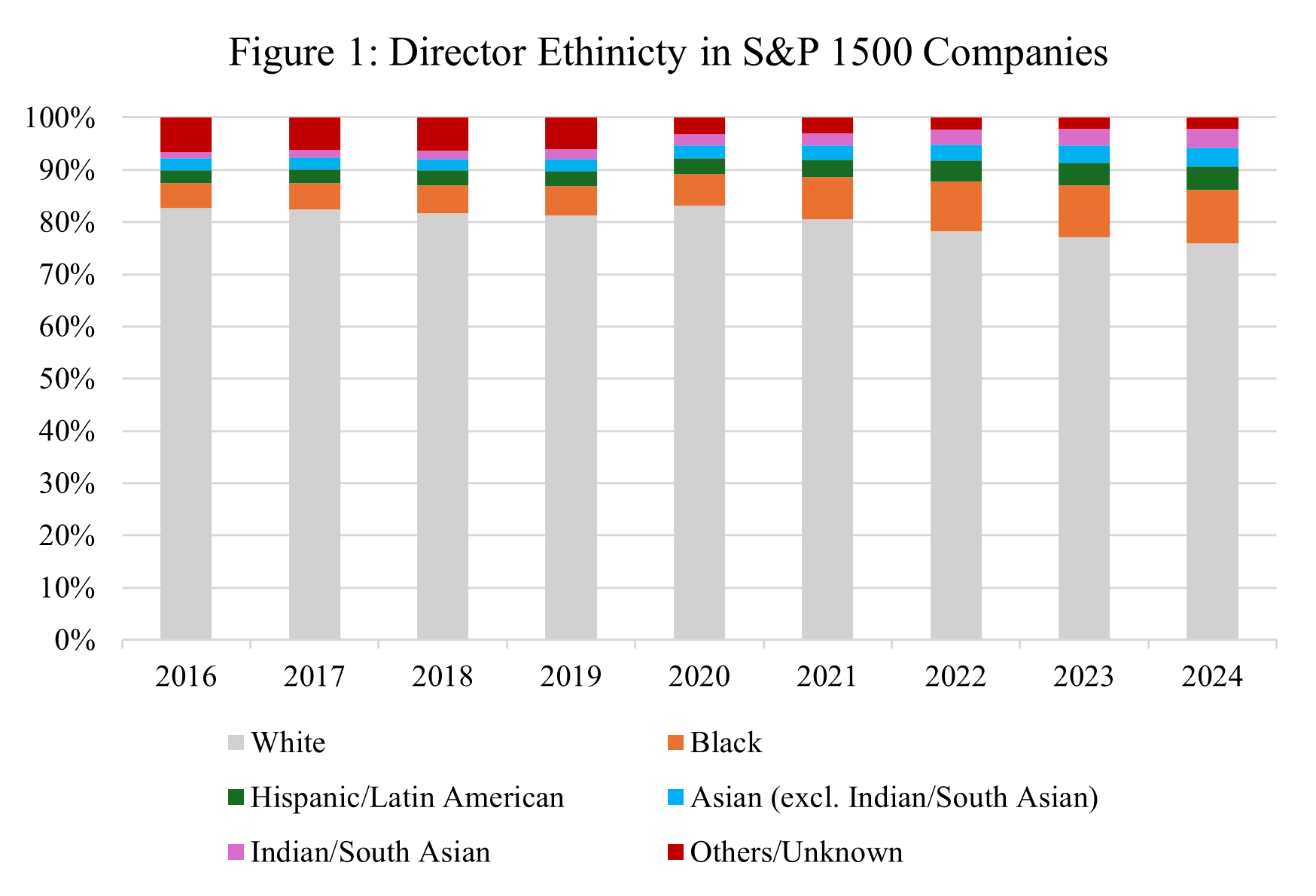
Source: Compiled by the author from ISS Directors US
Additionally, Figure 2 below shows that the share of female directors rose steadily from 18% to 32% during the same period. Gormley et al. found that pressure from the Big Three index funds “led American corporations to add at least 2.5 times as many female directors in 2019 as they had in 2016.”[61] They concluded that company boards achieved greater gender diversity by looking beyond managers’ existing networks for candidates and by focusing less on candidates’ executive experience.[62]
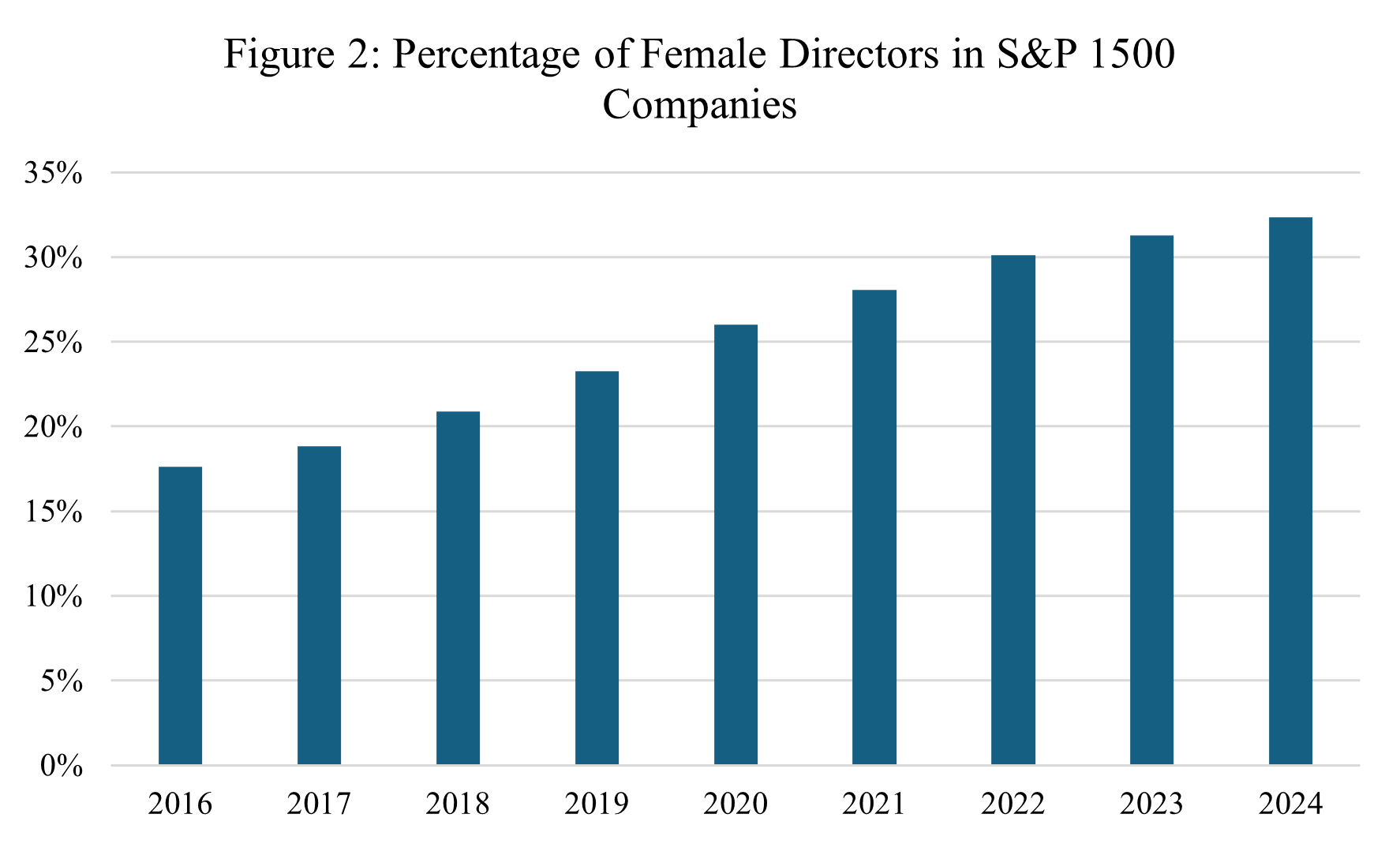
Source: Compiled by the author from ISS Directors US
III. Case Studies of DEI Backlash
After outlining the rise and fall of DEI in Part II, this part focuses on three notable cases of DEI backlash that happened after 2023: Bud Light, Target, and Cracker Barrel. While there are many more cases of DEI backlash, these three cases are representative of various risks: Bud Light represents backlash for embracing DEI; Target represents backlash for retreating from DEI; and Cracker Barrel represents the new danger of backlash for being “perceived” as DEI where seemingly neutral actions can trigger a politicized response.
A. Bud Light
In a video posted on Instagram on April 1, 2023, Bud Light partnered with transgender influencer Dylan Mulvaney to promote a Bud Light event for March Madness.[63] The collaboration quickly sparked online calls for a boycott against Bud Light that has been further amplified by conservative and right-wing influencers.[64] Within a month of the post, Anheuser-Busch, the producer of Bud Light beer, quickly reacted by putting two of its marketing executives on leave.[65]
But that did not stop the boycott. Researchers found that due to the boycott, Bud Light’s sales plummeted by 28% in the three months following the controversy compared to the same period in previous years.[66] While Bud Light sales fell nationally, the decline was more pronounced in Republican-leaning counties (-32%) compared to Democratic-leaning counties (-22%).[67] As a result of the boycott, Bud Light lost the title of top-selling beer in America to Modelo, its Mexican rival, for the first time in over twenty years.[68] Anheuser-Busch saw its revenue in North America plunge by $1.4 billion in 2023[69] and Bud Light’s sales continued to slump in the U.S. for 2024 and have yet to fully recover as of 2025.[70]
The CEO of Anheuser-Busch, Brendan Whitworth, later discussed the disastrous marketing failure: “[W]e never intended to be part of a discussion that divides people.”[71] But the Bud Light case is a classic example of “well-intentioned actions . . . backfir[ing] when they’re disconnected from consumer insight, cultural context, and brand strategy.”[72] Using sales data, researchers found that Bud Light’s customer base was almost split evenly between Democrat and Republican supporters, meaning that taking a stance on any politically sensitive issue could be potentially harmful to its business.[73] With DEI being caught in the culture wars, Bud Light may have alienated half of its customer base and set the stage for a self-inflicted customer uproar.
B. Target
Target was once seen as the poster child of supporting DEI. Being headquartered in Minneapolis, the city where the murder of George Floyd occurred, Target made bold commitments to DEI after the 2020 killing.[74] Target pledged to spend more than $2 billion with black-owned businesses and contribute $100 million in supporting black-led non-profit organizations and scholarships for historically black colleges and universities.[75] Under Target’s 2019-2021 DEI goals, it increased officers of color by 33%, increased promotion for people of color by 62%, increased promotion for women to senior leadership by 16%, and spent $1.78 billion on diverse suppliers.[76] As pressure began to build against DEI in 2023, then-CEO Brian Cornell defended Target’s DEI policy, arguing the focus on DEI “fueled much of our [Target’s] growth over the last 9 years.”[77]
The prologue of Target’s DEI troubles began in 2023 when it removed some of its 2023 Pride Month merchandise after backlash from conservative and right-wing groups—a move that sparked further backlash from LGBTQ+ rights groups.[78] The backlash from both sides caused Target’s sales to decline by 5% in the second quarter of 2023.[79] Target was later sued by Florida and a conservative group over the backlash for concealing risks concerning its DEI programs and Pride Month collections.[80]
The real test for Target came during the second term of President Trump. Sensing the political tide for DEI had changed, Target announced on January 24, 2025 that it would end its DEI programs, which included concluding its three-year DEI goals, halting external diversity surveys, and transforming the “Supplier Diversity” team to “Supplier Engagement.”[81] The retreat from DEI stoked anger among Target’s customer base, especially among its black customers who had spent $12 million per day at Target stores, and a boycott was orchestrated against Target.[82] Target’s sales dropped in the first two quarters of 2025, and its foot traffic fell while its competitor Costco saw an increase.[83] The boycott was costly for Target. Target announced that its CEO would step down in 2026 and it would lay off 1,000 corporate employees, amounting to 8% of its global workforce.[84] From the start of 2025, Target has lost one-third of its market capitalization.[85]
Because of a more progressive customer base and deeper commitments to DEI, Target experienced a larger and longer blowback when it ended its DEI programs compared to other companies that have done the same.[86] While some have pointed out that Target’s sales had already been on decline prior to the boycott, suggesting that the boycott was not the reason for Target’s poor performance, the negative media attention generated by the boycott certainly did not help, if not worsened Target’s situation.[87]
C. Cracker Barrel
Cracker Barrel, a company based in Tennessee that operates 660 restaurants famous for its Southern-style comfort food, announced in August 2025 that it was changing its classic logo as part of its rebranding efforts.[88] The new logo removed “Uncle Herschel,” who in the old logo sat on a wooden chair while leaning on a barrel, to only feature the brand name “Cracker Barrel” in a more simplistic style. The logo change was immediately met with outrage online.[89] Although the new logo did not seem to have an obvious connection to DEI,[90] conservatives accused the new logo change as going “woke,” and even President Trump called on Cracker Barrel to revert to its old logo on social media.[91]
The logo controversy caused Cracker Barrel’s shares to fall 13% in a single week.[92] In response to the backlash, Cracker Barrel swiftly announced it was returning to its original logo less than a month after announcing its new logo.[93] The desperate move was not able to save Cracker Barrel’s sales.[94] At the end of 2025, Cracker Barrel’s share price had more than halved since the disastrous logo change.[95] The CEO of Cracker Barrel, Julie Felss Masino, later came out to clarify that the logo change wasn’t meant to be ideological but was an attempt to make its logo more visible on highway billboards.[96]
In September 2025, activist investor Sardar Biglari launched a new proxy contest against Cracker Barrel, urging shareholders to vote against the reelection of Masino and another Board director, whom he blamed for the failed rebranding attempt.[97] Even though Masino secured her seat on the Board after winning enough votes from shareholders, she lamented in an interview: “I feel like I’ve been fired by America.”[98]
D. Summary
While all three companies suffered from customer backlash, there are nuanced differences in each of the cases. Bud Light and Target were clearly aware that they were engaging DEI policies. Their strategic error was failing to anticipate the backlash or underestimating the severity of the backlash. Unlike the other two cases, Cracker Barrel did not have an apparent intention of DEI with its new logo, but it nevertheless triggered backlash. Together, the three companies’ stories show that engaging DEI or actions being accused of engaging DEI could backfire and cause outrage from any and all directions irrespective of the current political climate.
One might say because Bud Light, Target, and Cracker Barrel are customer-facing brands, they attract more public attention making the backlash against them stronger and more persistent, but even non-customer-facing businesses cannot escape the controversy surrounding DEI. As the government controls various aspects of a business’s operations, the government can easily pursue its anti-DEI agenda through its broad regulatory apparatus. For instance, the Federal Communications Commission (FCC) directed AT&T to end its DEI program for its acquisition of wireless spectrum licenses to be approved, and AT&T heeded.[99] The U.S. Embassy in Paris even sent letters to French companies having U.S. government contracts asking them to certify that they had not practiced DEI programs.[100]
DEI has become a business risk that all companies must confront. As seen in this Part, companies may pay a heavy price for even a minor mistake in handling DEI. This leads to the question: Should companies still practice DEI? If so, then how? These questions will be discussed in the next part.
IV. Reexamining Cases for DEI
As discussed in Part II, the political attitude toward DEI shifted dramatically in the past few years. In such a fast-evolving environment, what might have been the case for DEI last year may not hold this year. A reexamination of DEI is therefore necessary. This part reexamines the business and legal cases for DEI.
A. Business Case
The business case has been a longstanding argument in favor of diversity, even before the term “DEI” became prevalent. It is based on the notion that diversity improves profitability and performance and thus benefits the company in the long term.[101] Following this rationale, greater board diversity has been said to reduce groupthink, thereby improving the quality of board decision-making by having directors from diverse backgrounds contributing their different perspectives.[102]
Despite the connection between diversity and firm performance being extensively studied, the empirical evidence remains inconclusive.[103] Many of the supporting studies come from consulting companies or industry reports,[104] but they do not share the same level of rigor as peer-reviewed academic research.[105] The results from academic literature present more of a mixed picture.[106] Meta-analyses of peer-reviewed articles have found no significant association between the number of female directors and company performance.[107] Katherine Klein, professor at Wharton School, concluded that there is no clear business case for board gender diversity based on the meta-analyses, and argued that “[w]omen should be appointed to boards for reasons of gender equality, but not because gender diversity on boards leads to improvements in company performance.”[108]
Even prior to the DEI backlash, the business case for DEI already appeared tenuous. As DEI became a target of the political-right, the business case may have turned against DEI. A recent study by Evans and Nochebuena-Evans, using a sample of eleven U.S.-listed companies that announced the elimination of DEI programs in 2024, found that companies saw abnormal stock returns in the following two days of the announcement.[109] The study went on to claim companies may benefit from eliminating DEI programs as they can “reallocate resources from potentially high-risk or low-yield initiatives to core business activities” and signal to “current and prospective investors a heightened focus on fiduciary responsibility and operational efficiency.”[110]
While further research is required before any certain conclusions can be made, companies should take note of preliminary research like this that casts doubt on the business case for DEI and reevaluate their business risk. The marketing of DEI should be distinguished from internal DEI programs because of the different target audiences and business calculations. Rather than looking at firm performance, the business case for DEI as a marketing tool rests on the customer base. Like any marketing design, it has to resonate with the customers,[111] which is not limited to end customers but may also include the government or other stakeholders. The risk of customer backlash increases with the polarization of the customer base, as shown in the case of Bud Light.[112] As American society’s view on DEI has become increasingly divided,[113] companies need to tailor their marketing message to their specific customer bases.
While the two categories of DEI are not mutually exclusive, if the marketing message is not backed up with real action, such performative DEI marketing increases the risk of backlash.[114] As was the case with Bud Light and Target, who have been accused of practicing “Rainbow Capitalism.”[115] To mitigate such risks, companies should align their marketing campaign with their actual practices.[116] And when rolling back DEI, companies should be transparent, authentic, and engage with stakeholders to “preserve their reputation and prevent backlash resulting from perceived inconsistency.”[117] As a former Bud Light executive commented: “When Anheuser-Busch embraced D.E.I., the partnership felt inauthentic. And that’s why it backfired.”[118]
As discussed in this section, the business case for DEI is unclear and should not be automatically accepted. But this does not lead to the conclusion that there is no business case for or against DEI—rather, it should be understood that there may be a business case for DEI, and this alone is enough for company boards to consider DEI.[119] With customer reaction to DEI being unpredictable under the current political polarization, companies should focus on their target market and brand positioning when engaging DEI internally or externally.[120] As the traditional business is now complicated by the reality that DEI may also drive significant reputational and financial loss, this shift in the economic calculus directly impacts the board’s legal responsibilities.
B. Legal Case
Having reexamined the business case, we now turn to the legal case. The legal case for DEI points to compliance with laws and regulations concerning DEI.[121] A company’s DEI actions can fall anywhere between a spectrum of statutory DEI mandated by law and voluntary DEI promoting DEI beyond legal obligations.[122] If the economic rationale for voluntary DEI has been eroding, directors must scrutinize the legal framework to justify their continued or discontinued commitment to DEI. This section explores how DEI fits into the broader corporate law framework. With the board of directors being tasked with steering the company, the answer lies in the director’s fiduciary duties. Given most of the largest corporations are incorporated in Delaware, this section will focus on Delaware law.
Statutory DEI actions flow from the corporate purpose to “conduct or promote any lawful business or purposes” under the Delaware General Corporation Law (DGCL).[123] For companies, DEI obligations mainly come from Title VII of the Civil Rights Act of 1964 and the EEOC created by the act. Fiduciary duties require that the directors make a good-faith effort to ensure the legal compliance of the company.[124] Such duty was recognized by the Delaware Chancery Court in In re Caremark International Inc. Derivative Litigation, holding that directors have a duty to monitor company compliance with the law.[125] This duty should cover any anti-discrimination and equal employment opportunity and other DEI-related laws and regulations.[126] As this category of DEI actions is mandated by law, companies must comply regardless of whether there is a business case.
However, for voluntary DEI actions, pursuing DEI beyond the legal minimum may potentially conflict with shareholder wealth maximization if the business case is weak. The classic case of Dodge v. Ford Motor Co.,decided by the Michigan Supreme Court in 1919, recognized the company’s duty to maximize shareholder wealth.[127] Milton Friedman’s famous essay in 1970, “The Social Responsibility of Business Is to Increase Its Profits,” has dictated the discussion of corporate purpose since then.[128] The notion of shareholder primacy has also long been affirmed in Delaware case law.[129] As presumptions that DEI will enhance company reputation or performance are overshadowed by the risk of backlash, do fiduciary duties still allow directors to undertake voluntary DEI actions?
The Business Judgment Rule offers broad protection to a board’s rational decisions, meaning that courts generally will not second-guess the board’s judgment absent gross negligence.[130] That is, in addition to complying with anti-discrimination laws, the board retains broad discretion to voluntarily undertake DEI actions if the board in good faith believes it is beneficial to the company.[131] The benefit should include long term benefits not evident at the time of action. The board may also reasonably determine that the company should have a DEI program to avoid legal risks and reputational harms.[132]
In Simeone v. Walt Disney Company, shareholders alleged that Disney’s directors and officers had breached their fiduciary duties by opposing the “Don’t Say Gay” bill.[133] While the case is a books and records demand under Section 220 of the DGCL, the Delaware Chancery Court explained that “Delaware law vests directors with significant discretion to guide corporate strategy—including on social and political issues. . . . The board is empowered to weigh these competing considerations and decide whether it is in the corporation’s best interest to act (or not act).”[134] The Court made it clear that while the plaintiff may disagree with Disney’s stance, “their disagreement is not evidence of wrongdoing.”[135]
Company boards are protected by the Business Judgment Rule that “is politically neutral and resistant to backlash politics,”[136] but this does not mean they are insulated from liability. As seen in the cases of Bud Light, Target, and Cracker Barrel, customer reaction to DEI actions could be highly unpredictable and may backfire in either or both directions. To make an informed decision required by the Business Judgment Rule, the board must have considered all risks associated with DEI; otherwise, the presumption of good faith under the Business Judgment Rule can be challenged.
C. The Way Forward?
This Part reexamined the business and legal cases for DEI against the backdrop of the wider culture wars. All this is not to say companies should abandon DEI altogether. Rather, with DEI being enshrined in the legal texts of the Civil Rights Act of 1964 and other anti-discrimination laws, companies are still required to satisfy the legal minimum DEI obligations. So, regardless of the political attitude toward DEI, companies should still be practicing DEI as part of their legal compliance exercise. But as DEI has become a “toxic acronym,”[137] companies should be cautious with publicizing DEI, especially using DEI for marketing purposes. As we have seen in Bud Light, Target, and Cracker Barrel, DEI marketing carries a significant risk of backfiring.
In light of the risks, a prudent board should consider refraining from publicizing DEI, whether it is to embrace or retreat from DEI, to prevent provoking a negative public reaction. The board should further consider avoiding the term “DEI” entirely and normalize DEI to become the company’s regular business operations.[138] An example is Target’s decision to rename its “Supplier Diversity” team to “Supplier Engagement” when it scaled back its DEI commitments.[139] Notwithstanding the risks, as there may still be a business case for DEI, the board should still actively consider DEI and may reasonably determine that “there is money to be made” with DEI marketing.[140] In such an event, fiduciary duties require the board to look at the company’s customer base to inform themselves of the associated risks.
V. Conclusion
Following ESG, DEI became a casualty of the culture wars rampant in American society. In today’s polarized social and political environment, companies must tread carefully on DEI issues. As seen with Bud Light, Target, and Cracker Barrel, DEI now represents a material business risk to all companies. Customer backlash is highly unpredictable and can be costly to a company. As the attack on DEI persists, this Article reexamined the business and legal cases for DEI. While the business case for DEI is unclear, given that there is a possibility that DEI may benefit the company, a prudent board should actively consider DEI. As for the legal case, companies should fulfill statutory DEI obligations as part of their legal compliance exercise. And given there may still be a business case, the board can voluntarily practice DEI beyond the legal minimum under the protection of the Business Judgment Rule. However, to mitigate the risk of adverse public reaction, the board should consider adopting a lower profile on DEI, which may entail limiting publicity regarding DEI initiatives or discontinuing the use of the acronym altogether.
Notwithstanding Corporate America’s retreat from DEI, companies are still bound by the law. The anti-discrimination and equal employment opportunity laws and regulations remain unchanged. DEI backlash is not an excuse to reject DEI. It merely teaches a lesson to companies not to treat DEI as a marketing ploy. Regardless of DEI backlash, companies cannot evade their legal obligations. The bottom line of corporate DEI remains the same given that companies must comply with the law, but the marketing of DEI creates substantial business risks. Ultimately, this Article foresees the era of performative DEI in marketing to be replaced by DEI driven through legal compliance.
[1] Owen Scott, Cracker Barrel CEO Says She Felt ‘Fired By America’ After Disastrous Rebrand, The Independent (Nov. 27, 2025), https://www.independent.co.uk/news/world/americas/julie-felss-masino-cracker-barrel-rebrand-b2873721.html.
[2]Diversity, Equity and Inclusion, Merriam-Webster, https://www.merriam-webster.com/dictionary/diversity%2C%20equity%20and%20inclusion (last visited Jan. 18, 2026).
[3]See, e.g., Inclusion & Diversity, Apple, https://www.apple.com/diversity/ (last visited Jan. 18, 2026).
[4] Elizabeth Blair, After Protests, Disney CEO Speaks Out Against Florida’s ‘Don’t Say Gay’ Bill, NPR (Mar. 10, 2022), https://www.npr.org/2022/03/08/1085130633/disney-response-florida-bill-dont-say-gay.
[5] Larry Buchanan, Black Lives Matter May Be the Largest Movement in U.S. History, Wall St. J (July 3, 2020), https://www.nytimes.com/interactive/2020/07/03/us/george-floyd-protests-crowd-size.html.
[6] Chris Brummer & Leo E. Strine, Jr., Duty and Diversity, Vand. L. Rev. 1, 1 (2022).
[7] Nicquel Terry Ellis, What Is DEI, and Why Is It Dividing America?, CNN (Jan. 23, 2025), https://www.cnn.com/2025/01/22/us/dei-diversity-equity-inclusion-explained.
[8] Lauren Aratani, How the US Supreme Court’s Affirmative Action Ruling Unleashed Anti-DEI Cases, The Guardian (Sep. 6, 2024), https://www.theguardian.com/law/article/2024/sep/06/dei-affirmative-action-lawsuits.
[9] Kate Gibson & Emmet Lyons, Meta Ends Diversity Programs, Joining McDonald’s, Walmart and Other Major Companies to Back Off DEI, CBS News (Jan. 16, 2025), https://www.cbsnews.com/news/meta-dei-programs-mcdonalds-walmart-ford-diversity/.
[10] Amanda Holpuch, Behind the Backlash Against Bud Light, N.Y. Times (Nov. 21, 2023), https://www.nytimes.com/article/bud-light-boycott.html.
[11] Nicquel Terry Ellis & Eva McKend, ‘A Spiritual Act of Resistance’: Black Consumers are Boycotting Corporations Retreating from DEI, CNN (Feb. 27, 2025), https://www.cnn.com/2025/02/27/us/black-consumers-boycotts-dei-target.
[12] Phil Helsel, Cracker Barrel Will Go Back to Old Logo After Conservative Backlash, NBC News (Aug. 26, 2025), https://www.nbcnews.com/business/business-news/cracker-barrel-logo-rcna227389.
[13] Veronica Root Martinez, Reframing the DEI Case, 46 Seattle U. L. Rev. 399, 403 (2023).
[14]Id. at 405.
[15]See, e.g., DeNeen Brown, Diversity, Equity, and Inclusion Programs, Britannica (Nov. 29, 2025), https://www.britannica.com/topic/diversity-equity-and-inclusion-programs (providing detailed introduction to the origins of DEI and its development between 1960s and 2020).
[16] Civil Rights Act of 1964 § 703, 42 U.S.C. § 2000e-2 (2018).
[17] Civil Rights Act of 1964 § 705-26, 42 U.S.C. § 2000e-4 to -5 (2018).
[18]See Janis Bowdler & Benjamin Harris, Racial Inequality in the United States, U.S. Dep’t of Treasury (July 21, 2022), https://home.treasury.gov/news/featured-stories/racial-inequality-in-the-united-states.
[19] Tatiana Walk-Morris, DEI is a Lightning Rod for Controversy – But the Practice Isn’t Dead, BBC (Mar. 5, 2024), https://www.bbc.com/worklife/article/20240304-us-corporate-diversity-equity-and-inclusion-programme-controversy.
[20] George Anders, Who’s Vaulting into the C-Suite? Trends Changed Fast in 2022, LinkedIn (Feb. 1, 2023), https://www.linkedin.com/pulse/whos-vaulting-c-suite-trends-changed-fast-2022-george-anders/?trackingId=jOiiEvmfQI6sMbG%2BKwpCIQ%3D%3D.
[21] Jeff Green et al., Corporate America Promised to Hire a Lot More People of Color. It Actually Did., Bloomberg (Sep. 26, 2023), https://www.bloomberg.com/graphics/2023-black-lives-matter-equal-opportunity-corporate-diversity/.
[22] Exec. Order No. 13985, 86 Fed. Reg. 7,009 (Jan. 20, 2021).
[23] Exec. Order No. 14305, 86 Fed. Reg. 34,593 (June 25, 2021).
[24] 17 C.F.R. § 229.407(c)(2)(vi) (2024); Regulation S-K, Sec. & Exch. Comm’n (June 20, 2025), https://www.sec.gov/rules-regulations/staff-guidance/compliance-disclosure-interpretations/regulation-s-k (Questions 116.11 and 133.13).
[25]Securities Exchange Act Release No. 34-92590, Sec. & Exch. Comm’n (August 6, 2021), https://www.sec.gov/files/rules/sro/nasdaq/2021/34-92590.pdf (order approving SR-NASDAQ-2020-081 and SR-NASDAQ-2020-082).
[26] Act of Sep. 30, 2018, ch. 954, 2018 Cal. Stat. 6263.
[27] Act of Sep. 30, 2020, ch. 316, 2020 Cal. Stat. For a detailed explanation of AB-979, see generally Sung Eun (Summer) Kim, Mandating Board Diversity, 97(5) Ind. L.J. Supplement 31 (2022).
[28] Michael Hatcher & Weldon Latham, States are Leading the Charge to Corporate Boards: Diversify!, Harv. L. Sch. F. on Corp. Governance (May 12, 2020), https://corpgov.law.harvard.edu/2020/05/12/states-are-leading-the-charge-to-corporate-boards-diversify/.
[29] Larry Fink, Larry Fink’s 2021 Letter to CEOs, BlackRock, https://www.blackrock.com/corporate/investor-relations/2021-larry-fink-ceo-letter (last visited Jan. 18, 2026).
[30] Jill Fisch, Promoting Corporate Diversity: The Uncertain Role of Institutional Investors, 46 Seattle U. L. Rev. 367, 371–72 (2023).
[31]Id. at 373.
[32]United States: Proxy Voting Guidelines Benchmark Policy Recommendation, ISS 61, 72-73 (Nov. 19, 2020), https://www.issgovernance.com/file/policy/2021/americas/US-Voting-Guidelines.pdf.
[33] Laura Noonan & Patrick Temple-West, Goldman to Insist Companies It Takes Public have Diverse Boards, Fin. Times (Jan. 23, 2020), https://www.ft.com/content/9a301780-3dfb-11ea-a01a-bae547046735.
[34] Elizabeth Bennett, US Business Leaders are Pushing Back Against Years of Corporate Diversity Efforts, BBC (Jan. 11, 2024), https://www.bbc.com/worklife/article/20240110-us-business-leaders-are-pushing-back-against-years-of-corporate-diversity-efforts.
[35] Elon Musk (@elonmusk), X (Dec. 14, 2023, 11:54 PM), https://x.com/elonmusk/status/1735568882499211557.
[36] Students for Fair Admissions v. President and Fellows of Harv. Coll., 600 U.S. 181 (2023).
[37] Crest v. Padilla, No. 20-STCV-37513 (LA Super. Ct., Apr. 1, 2022); Crest v. Padilla, No. 19-STCV-27561 (LA Super. Ct., May 13, 2022). See also Sarah Fortt et al., California Gender Board Diversity Law Is Held Unconstitutional, Harv. L. Sch. F. on Corp. Governance (June 22, 2022), https://corpgov.law.harvard.edu/2022/06/12/california-gender-board-diversity-law-is-held-unconstitutional/
[38] All. for Fair Bd. Recruitment v. SEC, No. 21-60626 (5th Cir. Dec. 11, 2024) (en banc). See also Joseph Kaufman, Fifth Circuit Vacates SEC’s Approval of Nasdaq Board Diversity Rules, Harv. L. Sch. F. on Corp. Governance (Jan. 12, 2025), https://corpgov.law.harvard.edu/2025/01/12/fifth-circuit-vacates-secs-approval-of-nasdaq-board-diversity-rules/.
[39]Ending Radical and Wasteful Government DEI Programs and Preferencing, White House (Jan. 20, 2025), https://www.whitehouse.gov/presidential-actions/2025/01/ending-radical-and-wasteful-government-dei-programs-and-preferencing/.
[40]Ending Illegal Discrimination and Restoring Merit-Based Opportunity, White House (Jan. 21, 2025), https://www.whitehouse.gov/presidential-actions/2025/01/ending-illegal-discrimination-and-restoring-merit-based-opportunity/.
[41] Lindsay Ellis & Ken Thomas, Trump’s War on DEI Freezes Diversity Work Across Federal Government, Wall St. J. (Jan. 22, 2025), https://www.wsj.com/politics/policy/trumps-war-on-dei-freezes-diversity-work-across-federal-government-9a596d29?mod=article_inline.
[42] Press Release, EEOC and Justice Department Warn Against Unlawful DEI-Related Discrimination U.S. Equal Emp. Opportunity Comm’n (Mar. 19, 2025), https://www.eeoc.gov/newsroom/eeoc-and-justice-department-warn-against-unlawful-dei-related-discrimination.
[43]Protecting American Investors from Foreign-Owned and Politically-Motivated Proxy Advisors, White House (Dec. 11, 2025), https://www.whitehouse.gov/presidential-actions/2025/12/protecting-american-investors-from-foreign-owned-and-politically-motivated-proxy-advisors/.
[44] Anne D’Innocenzio, Costco Successfully Defends Its Diversity Policies as Other US Companies Scale Theirs Back, AP (Jan 23, 2025), https://apnews.com/article/costco-shareholder-proposal-diversity-dei-0330f448741b35f2f788a36948ff3f95.
[45] Emma Goldberg, Aaron Krolik & Lily Boyce, How Corporate America Is Retreating from D.E.I., N.Y. Times (Mar. 13, 2025), https://www.nytimes.com/interactive/2025/03/13/business/corporate-america-dei-pol Nicquel Terry Ellis and Eva McKend, icy-shifts.html.
[46] Maria Aspan, Corporate America’s Retreat from DEI has Eliminated Thousands of Jobs, NPR (May 27, 2025), https://www.npr.org/2025/05/27/nx-s1-5307319/dei-jobs-trump.
[47] Matteo Tonello, The Evolving Landscape of DEI Shareholder Proposals, Harv. L. Sch. F. on Corp. Governance (Apr. 25, 2022), https://corpgov.law.harvard.edu/2025/04/25/the-evolving-landscape-of-dei-shareholder-proposals/.
[48]Id.; Nathaniel Meyersohn, DEI is Winning with Costco, Apple and Levi’s Shareholders, CNN (May 2, 2025), https://www.cnn.com/2025/05/02/business/costco-apple-levi-shareholders-dei (“Winning a shareholder vote is not the sole purpose of conservative groups bringing the proposals. Anti-DEI resolutions are an inexpensive way for activist shareholders to . . . keep up pressure on companies over their DEI policies . . . .”).
[49] Joe McGowan, In Annual Letter, BlackRock’s Larry Fink Omits Climate Change, DEI And ESG, Forbes (Mar. 31, 2025), https://www.forbes.com/sites/jonmcgowan/2025/03/31/in-annual-letter-blackrocks-larry-fink-omits-climate-change-dei-and-esg/.
[50] Jack Pitcher, BlackRock, a Diversity Pioneer, Distances Itself From DEI, Wall St. J. (Feb. 25, 2025), https://www.wsj.com/finance/investing/blackrock-a-diversity-pioneer-distances-itself-from-dei-24839d6c?gaa_at=eafs&gaa_n=AWEtsqcxv4t-WhiuI2Q9o1n5xLkr-fk6sDeViWo-16u8TWah1QHAqdzQGMKQ9p6ULAs%3D&gaa_ts=692fd1b6&gaa_sig=Kvh8xq37v_PEXpUuRJ6Hs-pT_SmzNdi40XQVwseU-oWexaQguxEUmqSZyL1HA7vYO7WpIcVRo_V6hlibvhdD0A%3D%3D.
[51] Ross Kerber, Vanguard Dials Back Diversity Language for US Corporate Boards, Reuters (Jan. 31, 2025), https://www.reuters.com/world/us/vanguard-dials-back-diversity-language-us-corporate-boards-2025-01-31/.
[52] Drew Hutchinson, Proxy Advisor ISS Retreats from Blanket ESG Voting Policy, Bloomberg L. (Nov. 25, 2025), https://news.bloomberglaw.com/esg/proxy-advisor-iss-retreats-from-blanket-esg-voting-guidelines.
[53] Isla Binnie & Saeed Azhar, Goldman Sachs Ends IPO Diversity Policy Citing Legal Developments, Reuters (Feb. 11, 2025), https://www.reuters.com/business/finance/goldman-sachs-ends-ipo-diversity-pledge-2025-02-11/.
[54]See, e.g., Erec Smith, There’s a Kind of Racism Embedded in DEI, Cato Inst. (Apr. 19, 2024), https://www.cato.org/commentary/theres-kind-racism-embedded-dei.
[55] Brummer & Strine, supra note 6,at 63–64.
[56] Martinez, supra note 13, at 408; Jamillah Bowman Williams, Beyond the Business Case: Moving from Transactional to Transformational Inclusion, 46 Seattle U. L. Rev. 299 ,327-28 (2023).
[57] Robin J. Ely & David A. Thomas, Getting Serious About Diversity: Enough Already with the Business Case, Har. Bus. Rev. (Nov.-Dec. 2020), https://hbr.org/2020/11/getting-serious-about-diversity-enough-already-with-the-business-case.
[58] Fisch, supra note 30, at 391–92.
[59] Pew Research Center & Forbes, Share of CEOs of Fortune 500 Companies Who Were Women from 1995 to 2024, Statista (Nov. 28, 2025), https://www.statista.com/statistics/691192/share-of-women-ceos-fortune-500/.
[60] Eva Roytburg, The Number of Black Fortune 500 CEOs is Still Abysmally Low. A ‘Shocking’ Corporate DEI Practice Might be to Blame, Stanford Professor Says, Fortune (June 19, 2024), https://fortune.com/2024/06/19/the-number-of-black-fortune-500-ceos-is-still-abysmally-low-a-shocking-corporate-dei-practice-might-be-to-blame-stanford-professor-says/.
[61]See Todd A. Gormley et al., The Big Three and Board Gender Diversity: The Effectiveness of Shareholder Voice, 149(2) J. Fin. Econ. 323, 323 (2023).
[62]Id.
[63] Dylan Mulvaney (dylanmulvaney), Instagram (April 1, 2023), https://www.instagram.com/p/CqgTftujqZc/?utm_source=ig_embed&utm_campaign=invalid&ig_rid=da8585ea-1968-4256-a82b-cc027a762c18.
[64] James Surowiecki, The Bitter Truth About the Bud Light Boycott, The Atlantic (June 19, 2023), https://www.theatlantic.com/ideas/archive/2023/06/bud-light-boycott-consumer-effect/674446/.
[65] Amanda Holpuch & Julie Creswell, 2 Executives Are on Leave After Bud Light Promotion with Transgender Influencer, N.Y. Times (Apr. 25, 2023), https://www.nytimes.com/2023/04/25/business/bud-light-dylan-mulvaney.html.
[66] Jura Liaukonyte et al., Lessons from the Bud Light Boycott, One Year Later, Harv. Bus. Rev. (Mar. 20, 2024), https://hbr.org/2024/03/lessons-from-the-bud-light-boycott-one-year-later
[67]Id.
[68] Dee-Ann Durbin, Bud Light Parent Says US Market Share Stabilizing After Transgender Promotion Cost Sales, AP (Aug. 3, 2023), https://apnews.com/article/bud-light-anheuser-busch-inbev-earnings-46b6412f84b5e8884caea941fc069d2f.
[69] Hanna Ziady, Bud Light Boycott Likely Cost Anheuser-Busch Inbev Over $1 Billion in Lost Sales, CNN Bus. (Feb. 29, 2024), https://www.cnn.com/2024/02/29/business/bud-light-boycott-ab-inbev-sales.
[70] Agustin Hays, Bud Light Hasn’t Recovered from Mulvaney Controversy, Ex-Anheuser-Busch Exec Says, Fox Busi. (Feb. 7, 2025), https://www.foxbusiness.com/media/bud-light-hasnt-recovered-from-mulvaney-controversy-ex-anheuser-busch-exec-says.
[71] Holpuch & Creswell, supra note 65.
[72] Gillian Oakenfull, What Bud Light’s Strategic Failure Teaches CMOs in a Post-DEI Market, Forbes (May 28, 2025), https://www.forbes.com/sites/gillianoakenfull/2025/01/27/bud-lights-dei-disaster-why-strategic-good-must-drive-brand-growth/.
[73] Liaukonyte et al., supra note 66.
[74] Nathaniel Meyersohn & Eva McKend, Target was One of the Most Outspoken Supporters of DEI. It’s Changed Its Tune., CNN (Feb. 3, 2025), https://www.cnn.com/2025/02/03/business/target-dei-walmart-amazon.
[75]Id.
[76]We Are Never Done: Inside Target’s 2019-2021 Diversity, Equity & Inclusion Journey — and Where We’re Going Next, Target (May 7, 2022), https://corporate.target.com/news-features/article/2022/03/diversity-and-inclusion-goals.
[77]Target CEO: DEI has ‘Fueled Much of Our Growth Over the Last 9 Years’, Fortune (May 17, 2023), https://fortune.com/2023/05/17/target-ceo-brian-cornell-interview-diversity-equity-inclusion/.
[78] Danielle Kaye, Target Says Backlash Against LGBTQ+ Pride Merchandise Hurt Sales, NPR (Aug. 16, 2023), https://www.npr.org/2023/08/16/1194176045/target-sales-lgbtq-pride-bud-light.
[79]Id.
[80] Nathaniel Meyersohn, Target is Getting Hit from All Sides on DEI, CNN (Feb. 21, 2025), https://www.cnn.com/2025/02/21/business/target-dei-lawsuit
[81]Target’s Belonging at the Bullseye Strategy, Target (Jan. 24, 2025), https://corporate.target.com/press/fact-sheet/2025/01/belonging-bullseye-strategy.
[82] Dara-Abasi Ita, Target Faces Boycott: 200 Days Without DEI, Financial Impact Grows, Investopedia (Sep. 26, 2025), https://www.investopedia.com/target-faces-boycott-without-dei-11804311.
[83]Id.
[84] Nathaniel Meyersohn, Target May Have Hit Rock Bottom, CNN (Nov. 19, 2025), https://www.cnn.com/2025/11/19/business/target-stock-economy.
[85]Id.
[86] Nathaniel Meyersohn, A 40-Day Target Boycott Starts Today. It Couldn’t Come at A Worse Time for the Company, CNN (Mar. 5, 2025), https://www.cnn.com/2025/03/05/business/target-boycott-jamal-bryant.
[87] Terry Tang, Pro-DEI Organizers Fired Up to Maintain Target Boycott as Promises Go Unfulfilled, AP (Aug. 27, 2025), https://apnews.com/article/target-walmart-ceo-boycott-dei-7996ce3fbf7f0cc9207472bc7a227cd6 (“Stacey Widlitz, president of investment research firm SW Retail Advisors, said she believes that Target’s sales malaise has more to do with its operational issues — messy stores and poorly stocked shelves — not from its pullback from DEI initiatives.”).
[88]Cracker Barrel Teams up with Country Music Star Jordan Davis to Invite Guests to Discover “All the More” this Fall, Cracker Barrel (Aug. 18, 2025), https://www.crackerbarrel.com/newsroom/news-releases/2025/aug/cracker-barrel-teams-up-with-country-music-star-jordan-davis.
[89]Cracker Barrel Unveils a New Logo as Part of Wider Rebrand Efforts, Sparking Ire Among Some Online, AP (August 21, 2025), https://apnews.com/article/cracker-barrel-new-logo-rebrand-efforts-67f3181a144cd639eb33d1066f85ef08.
[90] Megan Cerullo, Cracker Barrel Refreshed Its Logo and Paid the Price. Here’s What Brand Experts Say Went Wrong., CBS New (Aug. 7, 2025), https://www.cbsnews.com/news/cracker-barrel-logo-barrel-stock-cbrl-ceo/ (“I really doubt the Cracker Barrel executives sat down and said, ‘We’ll go through this enormously expensive undertaking to change all of our signage and everything on social media in order to change something because we feel we want to be ‘woke.’”).
[91] Phil Helsel, Cracker Barrel will Go Back to Old Logo after Conservative Backlash, NBC News (Aug. 26, 2025), https://www.nbcnews.com/business/business-news/cracker-barrel-logo-rcna227389.
[92]Id.
[93]We Hear You, Cracker Barrel, https://www.crackerbarrel.com/allthemore (last visited Jan. 18, 2026).
[94] Alexandra White, Cracker Barrel’s Logo Retreat Fails to Boost Restaurant Sales, Fin. Times (Dec. 10, 2025), https://www.ft.com/content/28493929-fa2b-4225-a503-f2acd991c600?shareType=nongift.
[95]Cracker Barrel Old Country Store Inc, CNBC, https://www.cnbc.com/quotes/CBRL (last visited Jan 18, 2026).
[96] Lauren Thomas, Cracker Barrel CEO Explains Short-Lived Logo Change, N.Y. Times (Oct. 21, 2025), https://www.wsj.com/business/cracker-barrel-ceo-explains-short-lived-logo-change-b0a1a5c7?gaa_at=eafs&gaa_n=AWEtsqdYYNREw3BYEiOdfu_g0t2p4o_iD_kTIQefHx2kLHnxY4F4UtvtRNMjh58lQ0s%3D&gaa_ts=6937b03c&gaa_sig=dn989d6MFmtvmG-dhOQOzY8Aotv5e9311507TZKawpy_l5QAU8LYgkJ2zJeqfcvtksUgOfxsZGn0rFRcrwUb9A%3D%3D.
[97] Heather Haddon, Cracker Barrel Targeted with Proxy Fight by Steak ‘n Shake Investor, Wall St. J. (Sep. 18, 2025), https://www.wsj.com/business/cracker-barrel-targeted-with-proxy-fight-by-steak-n-shake-investor-be8ad543?gaa_at=eafs&gaa_n=AWEtsqc0-hud7_QNdFJ9GCdgqUrmkOiwCq-iEP71iDdmp7S79bZgAJBTBrHk4uGQDPg%3D&gaa_ts=6937cddc&gaa_sig=MTMbE1hUvMqOdyAhqnyzDLZLMLSNhW2-6VUl4dk7VF9Hm35fzqzSuotiEnbqqW7xFBbCLxFh-JleXyQctVc8PQ%3D%3D.
[98] Scott, supra note 1.
[99] Reuters, AT&T commits to ending DEI programs, CNN (Dec. 2, 2025), https://www.cnn.com/2025/12/02/business/dei-at-and-t-mobile-fcc.
[100]Trump Administration Asks French Companies to Comply with DEI Ban, France 24 (Mar. 29, 2025), https://www.france24.com/en/europe/20250329-trump-diversity-equity-inclusion-dei-france-companies-executive-order-usa-europe-ban.
[101] Martinez, supra note 13, at 403.
[102] Fisch, supra note 30, at 375.
[103]Id.
[104]See, e.g., Diversity Wins: How Inclusion Matters, McKinsey & Co. (May 19, 2020), https://www.mckinsey.com/featured-insights/diversity-and-inclusion/diversity-wins-how-inclusion-matters#/.
[105] Fisch, supra note 30, at 375; Brummer & Strine, supra note 6, at 28–29.
[106] Fisch, supra note 30, at 375; Brummer & Strine, supra note 6, at 30–31.
[107] Corinne Post & Kris Byron, Women on Boards and Firm Financial Performance: A Meta-Analysis, 58(5) Acad. Mgmt. J. 1546 (2015); Jan Luca Pletzer et al., Does Gender Matter? Female Representation on Corporate Boards and Firm Financial Performance - A Meta-Analysis, 10(6) PLoS ONE e0130005 (2015).
[108] Katherine Klein, Does Gender Diversity on Boards Really Boost Company Performance?,
Knowledge Wharton (May 18, 2017), https://knowledge.wharton.upenn.edu/article/will-gender-diversity-boards-really-boost-company-performance.
[109] Robert D. Evans Jr. & Leiza Nochebuena-Evans, Corporate Social Anti-Activism and Firm Stock Price: Evidence from DEI Program Elimination, 76 Fin. Rsch. Letters 106968 (2025). Contra Fei Li et al., Will Diversity, Equity, and Inclusion Commitment Improve Manufacturing Firms’ Market Performance? A Signaling Theory Perspective on DEI Announcements, 34(3) Prod. & Operations Mgmt. 331 (2024) (finding DEI-commitment announcement made between 2013–2022 resulted in positive abnormal stock returns).
[110]Id.
[111]See Liaukonyte et al., supra note 66.
[112]Id.
[113] Felix Richter, Americans Divided in Their Views of DEI Initiatives, Statista(Jan. 23, 2025), https://www.statista.com/chart/33822/public-opinion-on-dei-programs-in-the-united-states/.
[114] Gillian Oakenfull, Meta, Amazon, McDonald’s: Marketing’s Role in The DEI Collapse, Forbes (Jan. 13, 2025), https://www.forbes.com/sites/gillianoakenfull/2025/01/13/meta-amazon-mcdonalds-marketings-role-in-the-dei-collapse/.
[115] Aaron Hicklin, We’ve Reached Rainbow Capitalism’s End, N.Y. Times (June 20, 2025), https://www.nytimes.com/2025/06/20/opinion/pride-month-rainbow-capitalism.html.
[116]Oakenfull, supra note 113.
[117] Sean Sands & Carla Ferraro, DEI Rollbacks: Consequences and Considerations for Brand Managers, Bus. Horizons (forthcoming).
[118] Anson Frericks, Working at Anheuser-Busch, I Saw What Went Wrong with the D.E.I. Movement, N.Y. Times (Mar. 11, 2025), https://www.nytimes.com/2025/03/11/opinion/anheuser-busch-dylan-mulvaney.html.
[119] Brummer & Strine, supra note 6, at 32–33.
[120] Sands & Ferraro, supra note 116.
[121] Martinez, supra note 13, at 405.
[122]See Brummer & Strine, supra note 6,at 66.
[123] Del. Code Ann. tit. 8 § 101(b).
[124] Brummer & Strine, supra note 6,at 71.
[125] In re Caremark International Inc. Derivative Litigation, 698 A.2d 959 (Del. Ch. 1996).
[126] Brummer & Strine, supra note 6,at 82–83.
[127] Dodge v. Ford Motor Co., 204 Mich. 459 (Mich. 1919).
[128] Milton Friedman, The Social Responsibility of Business Is to Increase Its Profits, N.Y. Times (Sept. 13, 1970), https://www.nytimes.com/1970/09/13/archives/a-friedman-doctrine-the-social-responsibility-ofbusiness-is-to.html.
[129] E.g., Unocal Corp. v. Mesa Petroleum Co., 493 A.2d 946 (Del. 1985); Revlon, Inc. v. MacAndrews & Forbes Holdings, Inc., 506 A.2d 173 (Del. 1986).
[130] Jennifer S. Fan, Woke Capital Revisited, 46 Seattle U. L. Rev. 421, 452–53 (2023).
[131] Id. at 457; Brummer & Strine, supra note 6,at 88.
[132] Brummer & Strine, supra note 6,at 89.
[133] For a thorough discussion of the case, see Lauren Getman, Simeone v. Walt Disney Company: How “the Magic Kingdom of Woke Corporatism” Found Protection in Delaware Court under 8 Del. C. § 220, 69 Vill. L. Rev. 33 (2024).
[134] Simeone v. Walt Disney Co., 302 A.3d 956 (Del. Ch. 2023).
[135] Id.
[136] Omari S. Simmons, Corporate Evolution, 46 Cardozo L. Rev. 1245, 1310 (2025).
[137] Maria Aspan, How Corporate America Got DEI Wrong, NPR (Feb. 3, 2025), https://www.npr.org/2025/02/03/nx-s1-5281168/corporate-america-dei-trump-diversity-business-stakeholder-capitalism.
[138]Id.; Walk-Morris, supra note 19.
[139]See supra Part III.B.
[140] Brummer & Strine, supra note 6,at 90.